What reading age do UK brands write for? Readability of 115 brands' blogs and press releases, 2015 to 2026
SGR-023, conducted 2026-10-27. Analyst: Jack Stovell, founder, ScriptGrain.
Question: What Flesch-Kincaid grade and UK reading age do UK brands' blog posts and press releases demand, how do sectors differ, are press releases harder to read than the same brand's blog posts, and did readability change between 2015 and 2026, including after the FCA's Consumer Duty came into force?
Summary
Background. Plain English is a stated aim for many organisations, and in financial services the FCA's Consumer Duty, in force from 31 July 2023, requires communications that retail customers are likely to understand. Readability formulas cannot say whether a reader understood a text, but they measure two things that make reading harder, long sentences and long words, and they can be applied to thousands of pages identically. We used them on the UK brand deep corpus our earlier studies built.
What we did. We fixed the formulas, the syllable counter, three hypotheses and the pass or fail rule for each in public before the full measurement. We then scored 15,540 pages (13,378,429 words of running prose) from 115 brands with Flesch Reading Ease, the Flesch-Kincaid grade and a UK reading age (grade plus five), alongside sentence length, syllables per word and the share of long words. The three hypotheses were that press releases are harder than the same brand's blog posts, that writing became harder to read between 2015 to 2018 and 2024 onward, and that banks and insurers became easier to read relative to other sectors once the Consumer Duty applied.
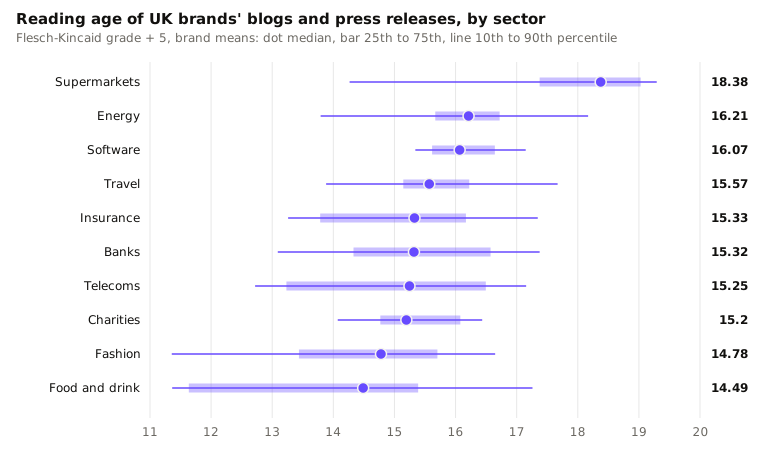
What we found. The median brand wrote at Flesch-Kincaid grade 10.7 (reading age 15.7, Flesch Reading Ease 51.4). By sector, supermarkets were hardest (reading age 18.4) and food and drink easiest (14.5). Within the same brand, press releases scored +2.76 grades (95% interval 2.26 to 3.23) against its blog posts, across 53 brands: supported. Within brand and channel, the Flesch-Kincaid grade moved +1.38 from 2015 to 2018 to 2024 onward (95% interval 0.85 to 1.95, 26 brand-channel pairs): supported, writing harder to read. A pre-registered check on how the pages were collected matters here: for 36 brands with both live and archived pages from 2019 to November 2022, the live pages scored +0.96 grades against the archived ones from the same years (95% interval 0.62 to 1.29). Every page from 2024 on is a live page and most dated pages from 2015 to 2018 are archived copies, so part of the change over time may come from how the pages were collected rather than from the writing. Banks and insurers changed +0.37 grades between before the Duty's final rules and after it came into force, other sectors +0.71; the difference was −0.34 (95% interval −1.55 to 1.00, 8 regulated and 18 other brands): not supported.
What it means. These are measures of sentence and word length. A page scored as hard may still be clear to its readers, and an easy score does not make a page well written. How a brand's score compares with the others is the finding, not whether a particular number is good.
Key numbers
- The median UK brand's blog and press writing scored Flesch-Kincaid grade 10.7, a reading age of 15.7 (ScriptGrain, 2026; 115 brands, 15,540 pages, pre-registered).
- Sector medians ran from a reading age of 14.5 (food and drink) to 18.4 (supermarkets).
- 23% of sentences were longer than 25 words, the length at which GOV.UK's guidance says to split a sentence; 10% of pages averaged more than 25 words a sentence.
- Within the same brand, press releases scored +2.76 Flesch-Kincaid grades against blog posts (2.26 to 3.23).
Sample
15,540 blog posts, press releases and product announcements from 115 UK brands in 10 sectors, taken from the brand deep corpus v1.4: 9,893 blog, 4,914 press, 733 announcement pages. 4,196 are archived originals captured between 2015 and November 2022 and 11,344 are live pages fetched on 4 and 5 October 2026.
- Blog posts, press releases and product announcements on the brand's own sites
- At least 150 words of main text, not link lists or menus, not duplicates of another page of the same brand
- At least 100 words and 5 sentences of running prose, so a formula has enough to measure
Method
Pre-registration: the formulas, the syllable counter, the text rules, three hypotheses and the analysis were committed to the public repository before the full measurement (docs/research/sgr-023-preregistration.md). The script was tested on under 5% of the data; the test results are not reported.
Text: each page's main text turned into plain text as in SGR-010 to SGR-018; only lines ending in a full stop, question mark or exclamation mark are scored. Numbers and web addresses are not words; hyphenated words count as separate words.
Syllables: fixed spelling rules, validated against the CMU Pronouncing Dictionary before the run, with the dictionary count used as a labelled sensitivity.
Press against blog: for each brand with at least 10 press releases and 10 blog posts, the average grade of its press releases minus that of its blog posts; supported if the lower end of the 95% interval of the mean over brands is above zero.
Change over time: for each brand and channel with at least 10 pages in 2015 to 2018 and 10 in 2024 onward, the change in average grade; supported (harder) if the lower end of the interval of the mean over brands is above zero, reversed (easier) if the upper end is below zero.
Consumer Duty: the change in average grade for banks and insurers from before July 2022 (the month the FCA published the final rules) to after July 2023 (the Duty in force), minus the same change in all other sectors; supported if the upper end of the interval is below zero.
Variables measured
- Flesch-Kincaid grade, UK reading age and Flesch Reading Ease
- Average sentence length and syllables per word
- Share of words of seven or more letters and of three or more syllables
- Share of sentences longer than 25 words
- Sector, channel, source, year
What each measure means
- Flesch Reading Ease
- 206.835 minus 1.015 times the average sentence length in words, minus 84.6 times the average syllables per word (Flesch, 1948). Higher is easier.
- Flesch-Kincaid grade
- 0.39 times the average sentence length in words, plus 11.8 times the average syllables per word, minus 15.59 (Kincaid et al., 1975). It estimates the US school grade needed to read the text.
- Reading age
- The Flesch-Kincaid grade plus five: US grade 1 is the school year for six-year-olds. It is a convention for translating the grade into a UK-style reading age, not a measured age, and we know no standards body that defines it.
- Running prose
- Only lines that end in a full stop, question mark or exclamation mark are scored. Headings, bylines, captions, buttons and unpunctuated list items are left out, so that page furniture does not count as very short sentences.
- Syllables
- Counted by a fixed set of spelling rules, with no dictionary at run time. Checked against the CMU Pronouncing Dictionary: 96.0% of the corpus's word occurrences matched the dictionary's count exactly and 99.95% were within one syllable.
- Brand-weighted
- Each brand's pages are averaged first, then brands are summarised, so a brand with many pages does not dominate. Medians and percentiles are across brands.
- 95% interval
- From 2,000 bootstrap resamples that draw whole brands with replacement within each sector.
Findings
- H1 (supported): press releases are harder to read than the same brand's blog posts (+2.76 grades (95% interval 2.26 to 3.23), 48 of 53 brands harder in press): Press release average minus blog average, Flesch-Kincaid grade, brands with at least 10 pages in each. Of the difference, +1.67 grades came from longer sentences and +1.10 from longer words. Supported if the lower end of the interval is above zero.
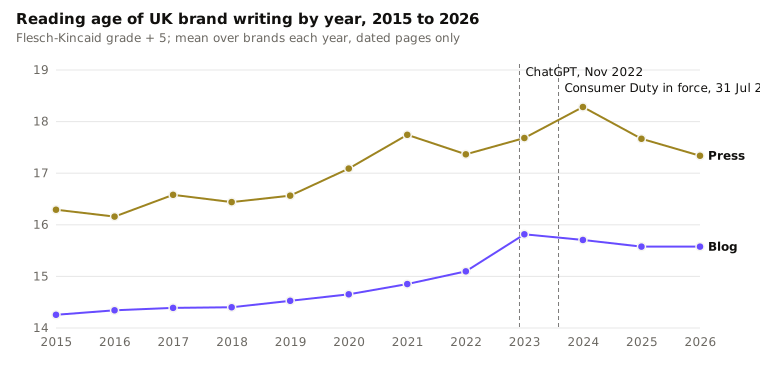
- H2 (supported): writing became harder to read between 2015 to 2018 and 2024 onward (+1.38 grades (95% interval 0.85 to 1.95), from 9.77 to 11.39): Within brand and channel, 26 pairs with at least 10 pages in each period. The prediction was that writing became harder, so the rule was that the lower end of the interval must be above zero; a fall whose interval is below zero is reported as reversed. A pre-registered check on how the pages were collected matters here: for 36 brands with both live and archived pages from 2019 to November 2022, the live pages scored +0.96 grades against the archived ones from the same years (95% interval 0.62 to 1.29). Every page from 2024 on is a live page and most dated pages from 2015 to 2018 are archived copies, so part of the change over time may come from how the pages were collected rather than from the writing.
- H3 (not supported): banks and insurers became easier to read relative to other sectors after the Consumer Duty (Difference in change −0.34 grades (95% interval −1.55 to 1.00)): 8 regulated brands changed +0.37 grades and 18 other brands +0.71. The regulated group did not clearly differ from the rest. Supported if the upper end of the interval is below zero.
What this study does not show
- That readers understood or failed to understand any page. Readability formulas measure sentence length and word length, not comprehension, and some of these pages are written for specialist readers.
- That any text was written by AI. A readability score describes sentence and word length, not authorship.
- That a change over time was caused by AI tools or by the FCA's Consumer Duty. The study is observational, and the Duty comparison asks only whether regulated sectors moved differently from the rest.
- That voice measurement, ScriptGrain's or anyone's, can tell whether a text was written by AI. Nothing in this study tests that.
Reading age by sector
Reading age by year
Pre-registered hypotheses and results
| Hypothesis | Result | Estimate (grades) | 95% interval | Brands or pairs |
|---|---|---|---|---|
| H1 press releases harder than blog posts | Supported | +2.76 | 2.26 to 3.23 | 53 |
| H2 harder in 2024 onward than 2015 to 2018 | Supported | +1.38 | 0.85 to 1.95 | 26 |
| H3 banks and insurers easier relative to other sectors after the Consumer Duty | Not supported | −0.34 | −1.55 to 1.00 | 8 and 18 |
Sectors
Brand-weighted medians and the spread between brands. Reading age is the Flesch-Kincaid grade plus five; Flesch Reading Ease is higher for easier text.
Sector medians mix channels, and in every sector press releases and announcements scored harder than blog posts at the median. 78% of the scored pages from supermarkets were press releases or announcements, against 36% of all pages, which pushes that sector up the table; within press releases and announcements alone, supermarkets still had the highest median (reading age 18.9), and within blog posts their median was 13.3. Figures for each sector and channel are in the summary file (JSON).
| Sector | Brands | Pages | Reading age (median) | 10th to 90th percentile | Flesch Reading Ease | Words per sentence | Syllables per word | Sentences over 25 words |
|---|---|---|---|---|---|---|---|---|
| Supermarkets | 10 | 577 | 18.4 | 14.3 to 19.3 | 39.5 | 23.7 | 1.66 | 38% |
| Energy | 11 | 1,943 | 16.2 | 13.8 to 18.2 | 49.9 | 20.1 | 1.62 | 24% |
| Software | 16 | 3,299 | 16.1 | 15.3 to 17.1 | 48.3 | 18.2 | 1.67 | 21% |
| Travel | 8 | 414 | 15.6 | 13.9 to 17.7 | 54.0 | 18.7 | 1.58 | 23% |
| Insurance | 10 | 2,024 | 15.3 | 13.3 to 17.3 | 56.1 | 19.3 | 1.57 | 22% |
| Banks | 18 | 2,641 | 15.3 | 13.1 to 17.4 | 55.3 | 19.2 | 1.57 | 24% |
| Telecoms | 15 | 1,781 | 15.2 | 12.7 to 17.2 | 54.6 | 18.3 | 1.58 | 21% |
| Charities | 10 | 1,959 | 15.2 | 14.1 to 16.4 | 54.3 | 18.0 | 1.58 | 21% |
| Fashion | 9 | 204 | 14.8 | 11.4 to 16.6 | 54.0 | 16.9 | 1.60 | 19% |
| Food and drink | 8 | 698 | 14.5 | 11.4 to 17.3 | 59.6 | 18.3 | 1.52 | 21% |
| All brands | 115 | 15,540 | 15.7 | 13.1 to 17.8 | 51.4 | 18.7 | 1.60 | 23% |
Blog posts, press releases and announcements
| Channel | Brands | Pages | Reading age (median) | 10th to 90th percentile | Flesch Reading Ease | Words per sentence | Syllables per word |
|---|---|---|---|---|---|---|---|
| Blog posts | 102 | 9,893 | 14.4 | 12.4 to 16.7 | 58.2 | 17.0 | 1.55 |
| Press releases | 91 | 4,914 | 17.8 | 14.1 to 19.9 | 42.4 | 22.1 | 1.67 |
| Product announcements | 66 | 733 | 14.9 | 13.0 to 17.4 | 54.6 | 18.1 | 1.59 |
Sentences or words: what makes a sector harder
The Flesch-Kincaid grade is the sum of a sentence-length term (0.39 times words per sentence) and a word-length term (11.8 times syllables per word). This table splits each sector's grade difference from the all-brand mean into the two.
| Sector | Grade minus all-brand mean | From sentence length | From syllables per word |
|---|---|---|---|
| Banks | −0.04 | +0.08 | −0.13 |
| Charities | −0.19 | −0.14 | −0.06 |
| Energy | +0.64 | +0.30 | +0.33 |
| Fashion | −1.20 | −1.04 | −0.17 |
| Food and drink | −1.41 | −0.39 | −1.03 |
| Supermarkets | +1.85 | +1.54 | +0.31 |
| Insurance | −0.36 | +0.06 | −0.41 |
| Software | +0.63 | −0.14 | +0.77 |
| Telecoms | −0.50 | −0.27 | −0.24 |
| Travel | +0.03 | −0.07 | +0.09 |
Against GOV.UK's sentence-length guidance
GOV.UK's writing guidance says: "Try to split up sentences that are over 25 words long." Across brands, 23.1% of sentences were over 25 words. 1.7% of brands averaged more than 25 words a sentence, and 38.7% of pages had more than a quarter of their sentences above that length. We did not find the current GOV.UK guidance stating a reading age, so we do not compare reading ages with a government target.
Each year
Brand-weighted mean over brands with dated pages that year (dates from page metadata, structured data, the URL or the archive capture).
| Channel | Year | Pages | Brands | Reading age | Flesch Reading Ease | Words per sentence | Syllables per word |
|---|---|---|---|---|---|---|---|
| All | 2015 | 356 | 51 | 15.4 | 54.0 | 18.9 | 1.58 |
| All | 2016 | 344 | 50 | 15.3 | 54.4 | 18.8 | 1.58 |
| All | 2017 | 425 | 61 | 15.7 | 52.8 | 19.2 | 1.59 |
| All | 2018 | 460 | 66 | 15.5 | 54.0 | 19.2 | 1.58 |
| All | 2019 | 771 | 73 | 15.2 | 55.1 | 18.8 | 1.57 |
| All | 2020 | 829 | 76 | 15.7 | 52.5 | 19.3 | 1.59 |
| All | 2021 | 1,117 | 81 | 16.1 | 51.0 | 19.9 | 1.60 |
| All | 2022 | 1,016 | 78 | 15.9 | 51.5 | 19.5 | 1.60 |
| All | 2023 | 485 | 54 | 16.7 | 47.3 | 20.3 | 1.64 |
| All | 2024 | 595 | 60 | 16.9 | 45.8 | 20.4 | 1.66 |
| All | 2025 | 683 | 68 | 16.7 | 46.0 | 19.6 | 1.67 |
| All | 2026 | 939 | 63 | 16.5 | 46.9 | 19.1 | 1.66 |
| Blog | 2015 | 230 | 31 | 14.3 | 59.6 | 17.3 | 1.53 |
| Blog | 2016 | 197 | 34 | 14.3 | 58.2 | 16.9 | 1.55 |
| Blog | 2017 | 265 | 37 | 14.4 | 58.5 | 17.3 | 1.55 |
| Blog | 2018 | 304 | 43 | 14.4 | 59.2 | 17.7 | 1.53 |
| Blog | 2019 | 574 | 56 | 14.5 | 58.4 | 17.8 | 1.54 |
| Blog | 2020 | 546 | 57 | 14.7 | 57.7 | 17.9 | 1.55 |
| Blog | 2021 | 707 | 65 | 14.9 | 56.5 | 18.0 | 1.56 |
| Blog | 2022 | 638 | 63 | 15.1 | 55.1 | 18.2 | 1.58 |
| Blog | 2023 | 321 | 38 | 15.8 | 50.6 | 18.6 | 1.63 |
| Blog | 2024 | 353 | 40 | 15.7 | 50.8 | 18.2 | 1.63 |
| Blog | 2025 | 399 | 44 | 15.6 | 50.5 | 17.5 | 1.64 |
| Blog | 2026 | 551 | 42 | 15.6 | 49.8 | 17.2 | 1.65 |
| Press and announcements | 2015 | 126 | 36 | 16.3 | 50.1 | 20.2 | 1.61 |
| Press and announcements | 2016 | 147 | 33 | 16.2 | 51.5 | 20.4 | 1.59 |
| Press and announcements | 2017 | 160 | 45 | 16.6 | 48.7 | 20.6 | 1.62 |
| Press and announcements | 2018 | 156 | 43 | 16.4 | 49.2 | 20.3 | 1.62 |
| Press and announcements | 2019 | 197 | 48 | 16.6 | 48.6 | 20.5 | 1.62 |
| Press and announcements | 2020 | 283 | 53 | 17.1 | 46.1 | 21.2 | 1.65 |
| Press and announcements | 2021 | 410 | 55 | 17.7 | 43.4 | 22.3 | 1.66 |
| Press and announcements | 2022 | 378 | 51 | 17.4 | 45.1 | 21.8 | 1.65 |
| Press and announcements | 2023 | 164 | 34 | 17.7 | 43.9 | 22.3 | 1.66 |
| Press and announcements | 2024 | 242 | 41 | 18.3 | 40.3 | 22.7 | 1.70 |
| Press and announcements | 2025 | 284 | 48 | 17.7 | 42.1 | 21.2 | 1.69 |
| Press and announcements | 2026 | 388 | 46 | 17.3 | 43.1 | 20.5 | 1.69 |
Checks on the three hypotheses
Each row repeats one hypothesis with one choice changed. Flesch Reading Ease rows have the opposite sign (a negative estimate means harder to read), and their result is stated in the direction of the hypothesis.
| Check | Result | Estimate | 95% interval | Brands or pairs |
|---|---|---|---|---|
| H1: the product's sentence splitter, all lines | Supported | +2.03 | 1.59 to 2.46 | 53 |
| H1: CMU dictionary syllables | Supported | +2.78 | 2.28 to 3.24 | 53 |
| H1: Flesch Reading Ease (a rise means easier) | Supported | −12.20 | −14.51 to −9.73 | 53 |
| H1: live pages only | Supported | +2.78 | 2.28 to 3.26 | 45 |
| H1: pages of 300 words or more | Supported | +2.94 | 2.48 to 3.38 | 51 |
| H1: brands with at least 5 pages in each channel | Supported | +2.72 | 2.25 to 3.17 | 55 |
| H1: announcements pooled with press | Supported | +2.21 | 1.77 to 2.65 | 60 |
| H2: the product's sentence splitter, all lines | Supported | +1.56 | 1.03 to 2.11 | 22 |
| H2: CMU dictionary syllables | Supported | +1.36 | 0.81 to 1.88 | 22 |
| H2: Flesch Reading Ease (a rise means easier) | Supported | −9.10 | −12.02 to −6.29 | 22 |
| H2: dates guessed from page text included | Supported | +1.16 | 0.73 to 1.58 | 30 |
| H2: pages of 300 words or more | Supported | +1.33 | 0.79 to 1.87 | 22 |
| H2: at least 5 pages per period | Supported | +1.23 | 0.68 to 1.74 | 27 |
| H2: average sentence length (words) | Not supported | +0.46 | −0.40 to 1.26 | 22 |
| H2: syllables per word | Supported | +0.10 | 0.07 to 0.13 | 22 |
| H2: blog posts only | Supported | +1.36 | 0.70 to 2.00 | 18 |
| H2: press releases and announcements only | Supported | +1.47 | 0.57 to 2.37 | 8 |
| H2: 2015 to 2018 against 2019 to November 2022 | Supported | +0.36 | 0.07 to 0.68 | 39 |
| H2: 2019 to November 2022 against 2024 onward | Supported | +0.40 | 0.04 to 0.78 | 36 |
| H3: the product's sentence splitter, all lines | Not supported | −0.17 | −1.08 to 0.73 | 26 |
| H3: CMU dictionary syllables | Not supported | −0.33 | −1.52 to 0.95 | 26 |
| H3: Flesch Reading Ease (a rise means easier) | Not supported | +1.50 | −5.51 to 7.72 | 26 |
| H3: before-period from January 2019 | Not testable | n/a | interval n/a | 25 |
| H3: dates guessed from page text included | Not supported | −0.49 | −1.22 to 0.27 | 47 |
| H3: supermarkets removed (some run FCA-regulated arms) | Not supported | −0.34 | −1.52 to 1.03 | 26 |
| H3: at least 5 pages per period | Not supported | −0.07 | −1.14 to 1.09 | 32 |
| H3: average sentence length (words) | Not supported | −0.53 | −2.04 to 1.24 | 26 |
| H3: syllables per word | Not supported | −0.01 | −0.07 to 0.05 | 26 |
| H3: banks only against other sectors | Not testable | n/a | interval n/a | 20 |
| H3: insurers only against other sectors | Not testable | n/a | interval n/a | 24 |
Checking the syllable counter
The counter was written from spelling rules and tuned on one half of the CMU Pronouncing Dictionary, then scored on the other half: 90.1% of words matched the dictionary's primary count exactly on the held-out half (99.7% within one syllable). On the words the brands actually used, 96.0% of occurrences matched and the average error was under 0.001 syllables a word. Page scores computed with the dictionary's counts where available correlated 0.998 with the main scores and differed by −0.02 grades on average. The dictionary is American-English pronunciation and covers 97.6% of the corpus's word occurrences.
Limitations
- Readability formulas measure sentence length and word length. They do not measure comprehension, layout, vocabulary a reader already knows, or whether the content suits its audience. A technical page for specialists can score as hard and still serve its readers.
- Reading age is the Flesch-Kincaid grade plus five, a convention for translating a US school grade, not a measured age of any reader.
- Syllables are counted by rules and are about nine in ten right per dictionary word, higher on common words. Names, acronyms and brand terms are approximate; the dictionary sensitivity shows how much that moves the results.
- Only running prose is scored. Pages whose content is mostly headings, lists and short labels are scored on what is left, and their scores describe that remainder.
- Pages were sampled by fixed rules from each brand's own sites, not at random from everything a brand published, and many pages carry no recoverable date. Archived pages (to November 2022) and live pages (after) came by different routes; the source check in the repository compares them.
- The Consumer Duty comparison cannot separate the Duty from anything else that affected banks and insurers differently over the same years. Some brands in other sectors, such as supermarkets, run FCA-regulated arms; one check removes them. The Duty's own wording concerns communications to retail customers, which may not be the blog and press pages measured here.
- UK consumer brands only, in the 10 sectors the earlier studies chose.
Competing interests
ScriptGrain sells writing-voice measurement and the analyst builds it; a finding that brands write at a high reading age could be used to sell a writing product. The hypotheses, the formulas and the pass and fail rules were committed to the public repository before the full measurement, every hypothesis is reported whichever way it came out, and the data and scripts are public.
Reproducing this
- Pre-registration, run script and entry builder: docs/research/sgr-023-preregistration.md and scripts/experiments/sgr-023/ in the ScriptGrain repository.
- Every page's URL, date and readability measures are in the data files, so any figure can be recomputed from the public pages.
Data
- Summary: hypotheses, intervals, levels, checks (JSON) (json)
- Every page: URL, date, words, sentences and readability measures (CSV) (csv)
- Every brand: averages overall and by channel (CSV) (csv)
- Sector and channel summary (CSV) (csv)
- Readability by year (CSV) (csv)
Released under CC BY 4.0: free to reuse, including commercially, with credit to ScriptGrain and a link to this page.
Citations
- ScriptGrain (2026). How do UK brands write? 16,070 blog posts and press releases, measured (SGR-010)
- Flesch, R. (1948). A new readability yardstick. Journal of Applied Psychology 32(3), 221 to 233
- Kincaid, J. P., et al. (1975). Derivation of New Readability Formulas (Automated Readability Index, Fog Count and Flesch Reading Ease Formula) for Navy Enlisted Personnel. Naval Technical Training Command Research Branch, February 1975 (DTIC ADA006655)
- GOV.UK (n.d.). Use clear language, in Writing to GOV.UK standards
- Financial Conduct Authority (2022). PS22/9: A new Consumer Duty
- Carnegie Mellon University. The CMU Pronouncing Dictionary
How to cite
ScriptGrain (2026). What reading age do UK brands write for? Readability of 115 brands' blogs and press releases, 2015 to 2026 (Study SGR-023, conducted 27 October 2026). Dataset licensed CC BY 4.0. https://scriptgrain.com/research/what-reading-age-do-uk-brands-write-for
About the analyst
Jack Stovell has worked in finance and data for more than twelve years, building management reporting, forecasting and profitability models for advertising agencies and tech scale-ups, from SQL and Power BI reporting to board-level analysis. Since 2016 he has run Adapt Progress Evolve, an applied AI studio, where he builds and operates AI systems and data products: ScriptGrain's measurement of writing voice across 45 attributes, UK Spend, which brings 16.7 million rows of UK council spending into one queryable dataset, and more than thirty AI agents running in production. He designs ScriptGrain's studies and is accountable for every number in them.