How do UK brands write? 16,070 blog posts and press releases, measured
SGR-010, conducted 2026-10-05. Analyst: Jack Stovell, founder, ScriptGrain.
Question: What is normal in the long-form writing of UK brands, by sector and by channel, and does a brand write the same way in its press releases as on its blog?
Summary
Background. Brand voice is usually described in adjectives: warm, clear, human. There are few published numbers for how brands actually write, and none we know of that compare one brand's channels with each other using the same instrument.
What we did. We gathered the blog posts, press releases, announcements and reports of 117 UK consumer brands, banks to charities, from their own sites and from the Wayback Machine (4,328 archived pages from 2015 to 2022), and measured every page of 150 words or more with ScriptGrain's code. We fixed two comparisons before measuring, each testing a brand against itself.
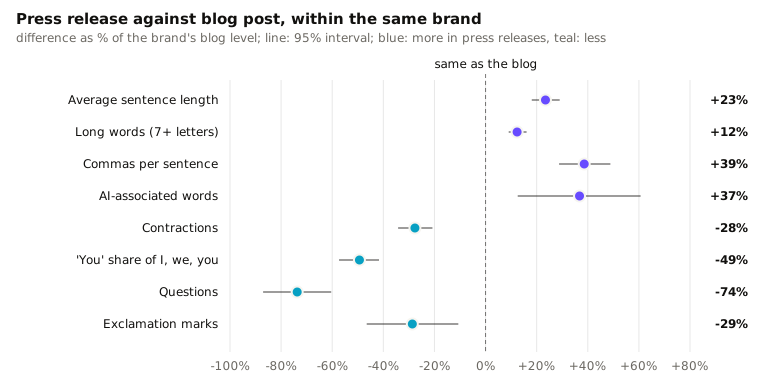
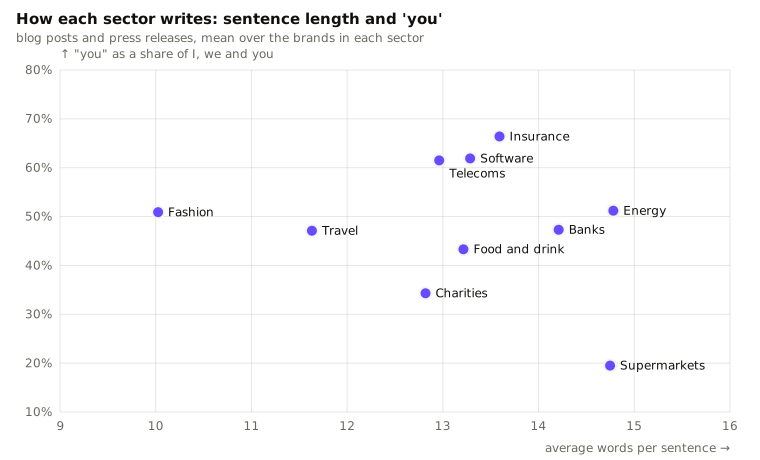
What we found. Press releases ran 2.9 words longer per sentence than the same brand's blog posts (23% longer), used 28% fewer contractions and 74% fewer questions, and spoke to "you" far less: "you" made up 30% of I, we and you in press releases and 61% on blogs. Sectors differed as much as channels: insurance brands wrote most to "you" (66%), supermarkets least (20%); fashion wrote the shortest sentences (10.0 words) and energy and supermarkets the longest.
What it means. A brand does not have one written voice. Its press office and its blog write measurably differently, and the sector sets much of the baseline. The tables give a normal range for each habit, by channel and sector, so a figure from any brand page can be read against what is typical for its kind.
Key numbers
- UK brands' press releases averaged 14.5 words per sentence, against 12.2 on their blogs (ScriptGrain, 2026; 16,070 pages from 117 brands).
- Within the same brand, press releases ran 2.9 words longer per sentence than blog posts (95% interval 2.2 to 3.5; 53 brands).
- "You" made up 61% of the words I, we and you on UK brand blogs, and 30% in the same brands' press releases.
- UK brand press releases asked 74% fewer questions and used 28% fewer contractions than the same brands' blog posts.
- Insurance brands wrote to "you" the most of ten UK sectors (66% of I, we and you); supermarkets the least (20%).
- Fashion brands wrote the shortest sentences of ten UK sectors (10.0 words on average); energy the longest (14.8).
- Software brands used AI-associated words most (2.12 per 1,000 words), 3.8 times as often as charities (0.56).
Sample
The brand deep corpus (October 2026): 117 UK consumer brands in 10 sectors (banks, energy, telecoms, software, supermarkets, travel, insurance, fashion, charities, food and drink). For each, blog posts, press releases, product announcements and information packs found on its own sites by fixed URL rules and fetched on 4 and 5 October 2026, plus archived pages from 2015 to November 2022. 11,742 live and 4,328 archived pages were measured.
- Written by the brand on its own site or newsroom (customer forums, help centres and other languages excluded)
- At least 150 words of main text
- Not a link list or menu (no more than 40% of words in lines of six words or fewer)
Method
Corpus: the brand deep corpus (October 2026): blog posts, press releases, product announcements and information packs from 122 UK consumer brands in 10 sectors, sampled by fixed rules from each brand's own sites, plus 4,845 archived pages from before ChatGPT's launch read from the Wayback Machine as they were published. Scripts and the full method: scripts/experiments/brand-corpus/ in the ScriptGrain repository.
Text measured: each page's main content (Firecrawl markdown) reduced to plain text, so menus and footers do not count. Pages under 150 words, exact duplicates within a brand, and pages where more than 40% of the words sit in lines of six words or fewer (link lists, menus) were excluded.
Measures: computed in code by ScriptGrain's own instruments, the same counts the free tools run. No language model read or scored any page.
Pre-registration: the hypotheses, eras, exclusions and tests for this series were committed to the public repository before any page was measured (docs/research/brand-series-preregistration.md). One rule was changed before any result was looked at, and the file records why.
Variables measured
- Average sentence length
- Sentence-length variation
- "You", "we" and "I" shares
- Contractions per 1,000 words
- Commas per sentence
- Questions and exclamation marks per 1,000 words
- Long-word share
- Em dashes per 1,000 words
- AI-associated words per 1,000 words
- AI sentence shapes per 1,000 words
What each measure means
- Average sentence length
- Words per sentence, from ScriptGrain's sentence splitter, averaged over a page.
- "You" share
- Uses of you, your and yours as a share of all uses of I, we and you words on the page. 100% means every personal pronoun addressed the reader.
- Contractions
- Words such as don't, we're and it's per 1,000 words.
- AI-associated words
- Uses per 1,000 words of three published word lists, each occurrence counted once: the 2024 words studies of scientific writing found language models over-use ("innovative", "utilized", "advancements", "pivotal", "facilitates", "firstly", "tackle", "showcasing"…), words publicly mocked as ChatGPT tells, and AI-era marketing words ("seamless", "elevate", "unlock", "empower", "streamline", "supercharge", "unleash", "effortless"…). The same measure as SGR-007. Humans use all of these words; the rate says nothing about who wrote a page.
- Brand-weighted
- Each brand's pages are averaged first, then brands are averaged, so a brand with many pages does not dominate a sector or a channel.
- 95% interval
- From 2,000 bootstrap resamples of brands, drawn within each sector.
Findings
- O1 (supported): press releases use longer sentences than the same brand's blog (+2.9 (95% interval 2.2 to 3.5) words per sentence): In 53 brands with at least 10 press releases and 10 blog posts each, the press release sentence was longer in the brand average. Press releases also used 12% more long words and 39% more commas per sentence.
- O2 (supported): blogs speak to "you" more than the same brand's press releases (+30 points of the I, we and you mix (95% interval 25 to 35)): Press releases are written about the company ("we", the brand name) and blogs to the reader. Questions follow the same split: blog posts asked 3.8 times as many questions as press releases.
- Exploratory: AI-associated words are more common in press releases (1.52 per 1,000 words in press releases, 1.02 on blogs): Within the same brands, press releases used 37% more of the listed words (95% interval 13% to 61%). That matches SGR-007, which found press releases were the densest home of these words before ChatGPT existed.
- Exploratory: sectors write differently ("You" from 20% (supermarkets) to 66% (insurance); sentences from 10.0 to 14.8 words): Sectors that sell to individuals over the phone and online (insurance, software, telecoms) wrote most to "you". Supermarkets and charities wrote most about themselves and their work. Food and drink brands used the most contractions (22.2 per 1,000 words). Sector figures rest on 8 to 18 brands each and carry no intervals.
What this study does not show
- That any page, or any brand, used AI to write. Word counts show style; humans used these words before ChatGPT and keep using them.
- That voice measurement, ScriptGrain's or anyone's, can tell whether a text was written by AI. Nothing in this study tests that.
- Whether one way of writing works better than another. Nothing here measures readers, sales or search.
Correction (5 October 2026)
Correction, 5 October 2026: 322 of the pages first measured came from other organisations' websites that a discovery rule had mistaken for the brands' own (mostly a US news site taken as EE's newsroom, 219 pages; also Aviva's separately branded asset manager, a newsroom-software company named Octopus and a publisher named Notion Press). They were removed and every analysis was re-run with its pre-registered rules unchanged.
No result changed. Figures that moved: pages measured 16,392 to 16,070; press release minus blog sentence length 2.7 to 2.9 words (54 to 53 brands); blog minus press 'you' share 29 to 30 points; telecoms 'you' share 57% to 62%. The first version's data is kept in the repository history.
Press release against blog post
How each sector writes
Pre-registered comparisons
| Comparison | Result | Within-brand difference | Brands |
|---|---|---|---|
| O1: press releases have longer sentences than the same brand's blog posts | Supported | +2.9 (95% interval 2.2 to 3.5) words | 53 |
| O2: blog posts have a higher 'you' share than the same brand's press releases | Supported | +30 points (25 to 35) | 53 |
Typical ranges by channel
Middle 50% of brands (25th to 75th percentile of brand averages), and the median brand.
| Measure | Blog: median brand | Blog: middle 50% | Press: median brand | Press: middle 50% |
|---|---|---|---|---|
| Average sentence length (words) | 12.6 | 10.8 to 13.9 | 14.6 | 12.4 to 17.1 |
| "You" share | 64% | 52% to 75% | 27% | 12% to 44% |
| Contractions per 1,000 words | 16.7 | 12.4 to 21.4 | 11.7 | 9.3 to 15.0 |
| Commas per sentence | 0.53 | 0.41 to 0.62 | 0.67 | 0.50 to 0.84 |
| Questions per 1,000 words | 3.8 | 2.7 to 5.5 | 0.9 | 0.2 to 2.1 |
| Exclamation marks per 1,000 words | 0.7 | 0.2 to 1.7 | 0.2 | 0.0 to 0.7 |
| Em dashes per 1,000 words | 2.3 | 1.3 to 3.1 | 1.8 | 0.8 to 2.9 |
| AI-associated words per 1,000 words | 0.81 | 0.38 to 1.42 | 1.02 | 0.59 to 1.84 |
| Long-word share (7+ letters) | 24% | 21% to 27% | 28% | 25% to 31% |
| Words per page | 1,046 | 827 to 1,317 | 785 | 616 to 1,037 |
By sector
Blog posts and press releases together, brand-weighted.
| Sector | Brands | Pages | Words per sentence | "You" share | Contractions per 1,000 | Em dashes per 1,000 | AI-associated words per 1,000 |
|---|---|---|---|---|---|---|---|
| insurance | 10 | 2,049 | 13.6 | 66% | 18.1 | 2.2 | 0.62 |
| software | 16 | 3,422 | 13.3 | 62% | 15.4 | 3.0 | 2.12 |
| telecoms | 15 | 1,816 | 13.0 | 62% | 17.5 | 2.4 | 1.28 |
| energy | 11 | 1,949 | 14.8 | 51% | 16.5 | 3.0 | 1.24 |
| fashion | 10 | 221 | 10.0 | 51% | 14.6 | 1.8 | 1.16 |
| banks | 18 | 2,669 | 14.2 | 47% | 16.3 | 2.3 | 0.96 |
| travel | 8 | 459 | 11.6 | 47% | 10.4 | 1.9 | 1.12 |
| food and drink | 8 | 751 | 13.2 | 43% | 22.2 | 2.0 | 0.90 |
| charities | 10 | 1,994 | 12.8 | 34% | 12.9 | 1.6 | 0.56 |
| supermarkets | 10 | 620 | 14.7 | 20% | 12.7 | 1.9 | 1.09 |
What was measured
| Pages | |
|---|---|
| Blog posts | 10,119 |
| Press releases | 5,058 |
| Product announcements | 773 |
| Information packs (PDF, first 25 pages) | 120 |
| Live pages (fetched October 2026) | 11,742 |
| Archived pages (2015 to November 2022) | 4,328 |
| Dated before 2019 | 2,155 |
| Dated 2019 to November 2022 | 4,519 |
| Dated December 2022 to 2023 | 930 |
| Dated 2024 to 2026 | 3,885 |
| No date found | 4,581 |
Limitations
- Pages were chosen by fixed URL rules from what each brand publishes, not at random, and brands publish very different amounts.
- Ten sectors of UK consumer brands; business-to-business brands, public bodies and other countries are not covered.
- Every measure is a count of surface features. None says whether writing is good, effective or on-brand.
- Sector figures rest on 8 to 18 brands each.
Competing interests
ScriptGrain sells writing-voice measurement and generation, and the analyst builds it. The comparisons, measures and exclusions were committed to the public repository before any page was measured, and the data and scripts are public.
Reproducing this
- Pre-registration and scripts: docs/research/brand-series-preregistration.md and scripts/experiments/brand-series/ in the ScriptGrain repository; corpus scripts in scripts/experiments/brand-corpus/.
- Every page is named by URL (and archive capture time where archived), so any page can be fetched and measured again.
Data
- Every page measured: brand, sector, channel, URL, date, every measure (CSV) (csv)
- Summary: percentiles by channel and sector, comparisons, intervals (JSON) (json)
Released under CC BY 4.0: free to reuse, including commercially, with credit to ScriptGrain and a link to this page.
Citations
How to cite
ScriptGrain (2026). How do UK brands write? 16,070 blog posts and press releases, measured (Study SGR-010, conducted 5 October 2026). Dataset licensed CC BY 4.0. https://scriptgrain.com/research/how-uk-brands-write
About the analyst
Jack Stovell has worked in finance and data for more than twelve years, building management reporting, forecasting and profitability models for advertising agencies and tech scale-ups, from SQL and Power BI reporting to board-level analysis. Since 2016 he has run Adapt Progress Evolve, an applied AI studio, where he builds and operates AI systems and data products: ScriptGrain's measurement of writing voice across 45 attributes, UK Spend, which brings 16.7 million rows of UK council spending into one queryable dataset, and more than thirty AI agents running in production. He designs ScriptGrain's studies and is accountable for every number in them.