Did brand writing change after ChatGPT? 37 UK brands, before and after
SGR-011, conducted 2026-10-05. Analyst: Jack Stovell, founder, ScriptGrain.
Question: Within the same brands, did blog posts and press releases written after ChatGPT use more of the words and habits associated with AI writing than those written before it?
Summary
Background. Readers say company writing has started to sound like ChatGPT: the same words, the same dashes, the same tidy sentences. That claim is usually made from impressions. Measuring it needs the same brands' writing from before ChatGPT, as it was published then, not as it reads after later edits.
What we did. We fixed five hypotheses before measuring anything. For UK brands with at least 10 pages from 2019 to November 2022 and at least 10 from 2024 to 2026 in the same channel (blog or press), we compared each brand with itself: the before pages read from the Wayback Machine as they were archived, the after pages from the live sites in October 2026. 37 brands qualified, across 49 brand-channel pairs. Every page was measured in code by ScriptGrain's instruments.
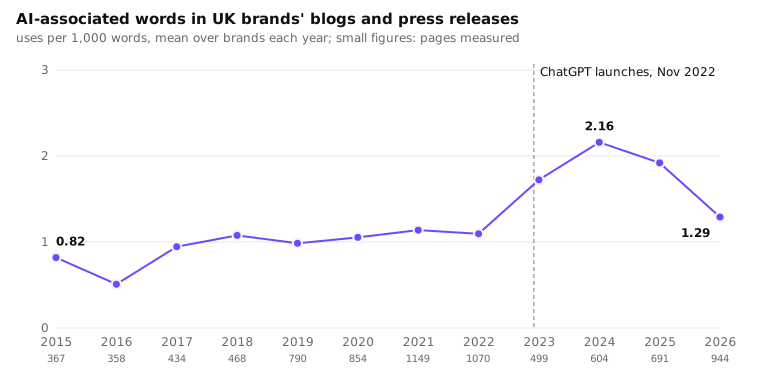
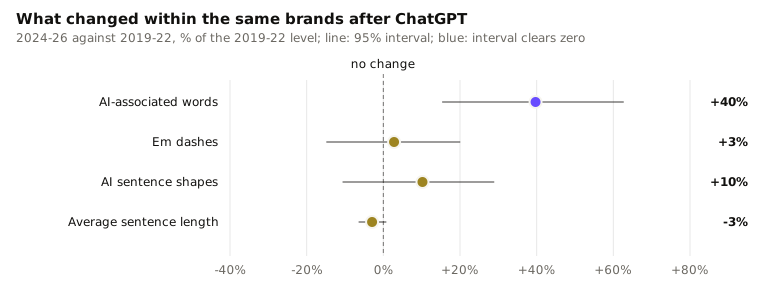
What we found. AI-associated words rose 40% within the same brands (1.03 to 1.44 per 1,000 words). The rise came from marketing words such as "seamless", "unlock" and "journey" and quieter ones such as "crucial" and "enhance", not from the famous tells: the 2024 words such as "delve" and "tapestry" rose less, and within chance. It was not clearly faster than the slow climb these words were already on from 2015 to 2022. Em dashes, AI-style sentence shapes and sentence length did not change. By calendar year, the words peaked in 2024 and fell back in 2026.
What it means. Brand writing did shift after ChatGPT, but in vocabulary, not punctuation or sentence structure, and partly along a trend that started years earlier. The habits people most often point to as signs of AI writing, the em dash above all, did not change in these brands' writing. A rise in a word list describes style; it does not show who, or what, wrote any page.
Key numbers
- UK brands' blog posts and press releases used 40% more AI-associated words in 2024 to 2026 than the same brands' writing from 2019 to 2022 (ScriptGrain, 2026; 37 brands, pre-registered).
- Marketing words such as "seamless", "unlock" and "journey" rose 45% in UK brands' writing after ChatGPT; the 2024 tells such as "delve" did not rise beyond chance.
- Em dashes did not rise beyond chance in UK brands' writing after ChatGPT: 2.43 per 1,000 words before and 2.50 after, within the same 37 brands.
- AI-associated words in UK brand writing peaked in 2024 at 2.16 per 1,000 words, against 1.07 in 2019 to 2022, and fell to 1.29 in 2026.
- The rise in AI-associated words came from brand blogs (+63%), not press releases, where the change was within chance.
- Sentence shapes associated with AI writing, such as "not X but Y", did not rise beyond chance in UK brands' writing after ChatGPT (0.24 to 0.26 per 1,000 words).
Sample
UK consumer brands from the brand deep corpus (October 2026) with at least 10 dated pages in the same channel both before (2019 to November 2022) and after (2024 to 2026): 37 brands and 49 brand-channel pairs. Before pages are mostly the archived originals from the Wayback Machine; after pages come from the brands' live sites, fetched on 4 and 5 October 2026.
- Blog posts, press releases and product announcements on the brand's own sites
- At least 150 words of main text; link lists and menus excluded
- A date from metadata, structured data, the URL or the archive capture
- At least 10 pages before and 10 after in the same brand and channel
Method
Corpus: the brand deep corpus (October 2026): blog posts, press releases, product announcements and information packs from 122 UK consumer brands in 10 sectors, sampled by fixed rules from each brand's own sites, plus 4,845 archived pages from before ChatGPT's launch read from the Wayback Machine as they were published. Scripts and the full method: scripts/experiments/brand-corpus/ in the ScriptGrain repository.
Text measured: each page's main content (Firecrawl markdown) reduced to plain text, so menus and footers do not count. Pages under 150 words, exact duplicates within a brand, and pages where more than 40% of the words sit in lines of six words or fewer (link lists, menus) were excluded.
Measures: computed in code by ScriptGrain's own instruments, the same counts the free tools run. No language model read or scored any page.
Pre-registration: the hypotheses, eras, exclusions and tests for this series were committed to the public repository before any page was measured (docs/research/brand-series-preregistration.md). One rule was changed before any result was looked at, and the file records why.
Tests: within-brand change in brand-weighted means, with 95% intervals from 2,000 bootstrap resamples of brands within sectors (fixed seed). H2 compares the per-year rate of change from 2015-18 to 2019-22 with that from 2019-22 to 2024-26, for brands with all three eras. Analyses beyond H1 to H5 are labelled exploratory.
Variables measured
- AI-associated words per 1,000 words (and each word list)
- AI sentence shapes per 1,000 words
- Em dashes per 1,000 words
- Average sentence length
- Contractions per 1,000 words
- "You" share
What each measure means
- Before and after
- Before: pages published from January 2019 to November 2022 (ChatGPT launched on 30 November 2022). After: January 2024 to October 2026. 2023 is left out of the main test as a transition year and reported separately. The 2015 to 2018 pages are used only to test whether the change is a continuing trend.
- Within-brand change
- For each brand and channel (blog, or press releases and announcements together), the average after a page minus the average before; then averaged over brands, each brand counting once. A brand is compared only with itself, so a shift in which brands are measured cannot create a trend.
- AI-associated words
- Uses per 1,000 words of three published word lists, each occurrence counted once: the 2024 words studies of scientific writing found language models over-use ("innovative", "utilized", "advancements", "pivotal", "facilitates", "firstly", "tackle", "showcasing"…), words publicly mocked as ChatGPT tells, and AI-era marketing words ("seamless", "elevate", "unlock", "empower", "streamline", "supercharge", "unleash", "effortless"…). The same measure as SGR-007. A separate list of quieter words ("crucial", "comprehensive", "insights", "additionally", "potential", "significant"…) is reported on its own.
- AI sentence shapes
- The free AI cliché checker's scan for 'not X but Y' balancing, reflexive lists of three, chains of semicolons and stock phrases, per 1,000 words.
- Dates
- From the page's own metadata, its structured data, its URL, or (for archived pages) the month it was first archived, which is a latest possible date. Dates guessed from the page text are left out of the main test and added back in a sensitivity check.
- 95% interval
- From 2,000 bootstrap resamples of brands, drawn within each sector. A hypothesis counts as supported only if the interval excludes zero in the predicted direction (for H5, if the 90% interval sits inside ±1.5 words).
Findings
- H1 (supported): AI-associated words rose within the same brands (+0.41 (95% interval 0.16 to 0.65) per 1,000 words, +40%): From 1.03 to 1.44 per 1,000 words across 37 brands. By word list: AI-era marketing words +45% (interval clears zero), the quieter LLM-favoured words +74% (clears zero), the 2024 tells such as "delve" +20% and the publicly mocked words +22% (neither clears zero).
- H2 (not supported): the rise was not clearly a break from the trend before (0.086 per 1,000 words a year after, against 0.060 a year from 2015-18 to 2019-22): For the 22 brands with pages in all three eras, the yearly rise after ChatGPT was larger, but the difference (+0.026, 95% interval −0.049 to 0.101) includes zero. These words were already climbing in brand writing before ChatGPT, as SGR-007 found in books and the web. The calendar-year series below shows a sharper jump in 2023 and 2024 than this per-year test can resolve.
- H3 (not supported): em dashes did not rise (2.43 to 2.50 per 1,000 words; change +0.07 (95% interval −0.36 to 0.49)): Despite the 'ChatGPT dash' reputation, brand writing used em dashes at the same rate after ChatGPT as before. Exploratory: press releases did gain dashes (+0.52, 95% interval 0.11 to 0.91), blog posts did not (−0.15, 95% interval −0.67 to 0.37).
- H4 (not supported): AI sentence shapes did not rise (0.24 to 0.26 per 1,000 words; change +0.02 (95% interval −0.03 to 0.07)): 'Not X but Y' constructions, reflexive lists of three and the cliché checker's stock phrases were as rare after ChatGPT as before.
- H5 (supported): sentence length stayed within 1.5 words (14.7 to 14.3 words; change −0.43 (95% interval −0.95 to 0.12)): The 90% interval (−0.88 to 0.02) sits inside ±1.5 words. Sentences got slightly shorter, if anything.
- Robustness: the result held under every pre-registered check (H1 with text dates added +0.53 (95% interval 0.32 to 0.73); with 2023 counted as after +0.37 (95% interval 0.13 to 0.60)): Archived and live copies of 2019-22 pages (39 brands with both) used AI-associated words at the same rate (difference +0.10, 95% interval −0.15 to 0.32), so mixing archived before-pages with live after-pages does not create the rise. Live copies did carry fewer em dashes (−0.39, 95% interval −0.70 to −0.08) and slightly longer sentences than their archived versions, a sign some old pages were edited since.
What this study does not show
- That any page, or any brand, used AI to write. Word counts show style; humans used these words before ChatGPT and keep using them.
- That voice measurement, ScriptGrain's or anyone's, can tell whether a text was written by AI. Nothing in this study tests that.
- Why the words rose. Writers read AI-written text, agencies and tools changed, and topics shifted (more about AI itself); this study measures the change, not its cause.
Correction (5 October 2026)
Correction, 5 October 2026: 322 of the pages first measured came from other organisations' websites that a discovery rule had mistaken for the brands' own (mostly a US news site taken as EE's newsroom, 219 pages; also Aviva's separately branded asset manager, a newsroom-software company named Octopus and a publisher named Notion Press). They were removed and every analysis was re-run with its pre-registered rules unchanged.
No hypothesis changed outcome. Figures that moved: AI-associated words +39% to +40% within brand (38 to 37 brands); em dashes 2.41 to 2.57 became 2.43 to 2.50 per 1,000 words; the 2024 peak 2.14 to 2.16. The first version's data is kept in the repository history.
AI-associated words, year by year
Exploratory. Each year is the mean over the brands with pages that year, so the brand mix varies from year to year; the pre-registered tests above compare each brand only with itself.
What changed, within the same brands
Pre-registered hypotheses and results
| Hypothesis | Result | Within-brand change (95% interval) |
|---|---|---|
| H1: AI-associated words rose | Supported | +0.41 (95% interval 0.16 to 0.65) per 1,000 words |
| H2: the rise after ChatGPT was faster than the trend before it | Not supported | +0.026 (95% interval −0.049 to 0.101) per 1,000 words a year |
| H3: em dashes rose | Not supported | +0.07 (95% interval −0.36 to 0.49) per 1,000 words |
| H4: AI sentence shapes rose | Not supported | +0.02 (95% interval −0.03 to 0.07) per 1,000 words |
| H5: average sentence length changed by less than 1.5 words | Supported | −0.43 (95% interval −0.95 to 0.12) words; 90% interval −0.88 to 0.02 |
By word list and habit
Within-brand change from 2019-22 to 2024-26, same brands as H1.
| Measure | Before | After | Change (95% interval) |
|---|---|---|---|
| AI-associated words (H1) | 1.03 | 1.44 | +0.41 (95% interval 0.16 to 0.65) |
| AI-era marketing words | 0.75 | 1.09 | +0.34 (95% interval 0.15 to 0.52) |
| Quieter LLM-favoured words | 1.03 | 1.80 | +0.77 (95% interval 0.50 to 1.06) |
| 2024 tells (delve and others) | 0.27 | 0.33 | +0.06 (95% interval −0.04 to 0.14) |
| Publicly mocked ChatGPT words | 0.09 | 0.11 | +0.02 (95% interval −0.02 to 0.06) |
| Em dashes | 2.43 | 2.50 | +0.07 (95% interval −0.35 to 0.48) |
| AI sentence shapes | 0.24 | 0.26 | +0.02 (95% interval −0.02 to 0.07) |
| Average sentence length | 14.7 | 14.3 | −0.4 (95% interval −0.9 to 0.1) |
| Contractions | 15.4 | 14.9 | −0.6 (95% interval −1.7 to 0.5) |
| "You" share | 0.45 | 0.48 | +0.03 (95% interval −0.00 to 0.06) |
| Sentence-length variation | 0.73 | 0.72 | −0.01 (95% interval −0.04 to 0.02) |
Blog posts and press releases separately
| Measure | Blog change (95% interval) | Press change (95% interval) |
|---|---|---|
| AI-associated words | +0.56 (95% interval 0.31 to 0.82) (27 brands) | +0.25 (95% interval −0.06 to 0.59) (22 brands) |
| Em dashes | −0.15 (95% interval −0.67 to 0.37) (27 brands) | +0.52 (95% interval 0.11 to 0.91) (22 brands) |
| AI sentence shapes | +0.05 (95% interval −0.00 to 0.10) (27 brands) | +0.00 (95% interval −0.08 to 0.09) (22 brands) |
| Average sentence length | −0.40 (95% interval −1.01 to 0.18) (27 brands) | −0.48 (95% interval −1.15 to 0.20) (22 brands) |
Year by year
Exploratory; brand-weighted means of the brands with dated pages each year.
| Year | Pages | Brands | AI-associated words | Em dashes | AI sentence shapes | Words per sentence |
|---|---|---|---|---|---|---|
| 2015 | 367 | 52 | 0.82 | 2.36 | 0.27 | 12.8 |
| 2016 | 358 | 52 | 0.51 | 2.34 | 0.23 | 12.6 |
| 2017 | 434 | 61 | 0.95 | 2.52 | 0.28 | 13.0 |
| 2018 | 468 | 66 | 1.08 | 3.07 | 0.21 | 14.0 |
| 2019 | 790 | 73 | 0.99 | 2.65 | 0.34 | 13.4 |
| 2020 | 854 | 76 | 1.05 | 2.62 | 0.26 | 14.2 |
| 2021 | 1,149 | 81 | 1.14 | 2.41 | 0.22 | 14.5 |
| 2022 | 1,070 | 80 | 1.10 | 2.66 | 0.22 | 14.3 |
| 2023 | 499 | 57 | 1.72 | 3.01 | 0.27 | 14.4 |
| 2024 | 604 | 61 | 2.16 | 2.61 | 0.26 | 15.0 |
| 2025 | 691 | 70 | 1.92 | 2.85 | 0.19 | 14.2 |
| 2026 | 944 | 64 | 1.29 | 2.51 | 0.28 | 13.9 |
By sector
Exploratory. Within-brand change in AI-associated words, sectors with at least 3 eligible brands.
| Sector | Brands | Before | After | Change (95% interval) |
|---|---|---|---|---|
| banks | 3 | 0.94 | 1.54 | +0.61 (95% interval 0.49 to 0.80) |
| energy | 4 | 1.09 | 1.49 | +0.40 (95% interval −0.15 to 1.15) |
| telecoms | 4 | 0.88 | 1.32 | +0.44 (95% interval −0.53 to 1.33) |
| software | 10 | 1.84 | 2.41 | +0.57 (95% interval −0.12 to 1.17) |
| insurance | 7 | 0.60 | 0.81 | +0.21 (95% interval −0.17 to 0.65) |
| charities | 7 | 0.54 | 0.67 | +0.13 (95% interval −0.24 to 0.48) |
Limitations
- Before pages are mostly archived copies and after pages are live. The source check above found no difference in AI-associated words between archived and live copies of the same era, but live copies had fewer em dashes, so the em dash comparison may understate any rise.
- A page's date is its publication date where the page says so, and otherwise the month it was first archived (a latest possible date).
- Word lists count spellings. These words rose in human writing for decades before ChatGPT, and topics shifted too: brands now write more about AI itself.
- Brands publish different amounts, and only brands with enough pages in both eras are in the test, which favours brands with active blogs and newsrooms.
- UK consumer brands only.
Competing interests
ScriptGrain sells writing-voice measurement and generation, and the analyst builds it. The hypotheses, eras, measures and tests were committed to the public repository before any page was measured, every result is reported whether it passed or failed, and the data and scripts are public.
Reproducing this
- Pre-registration and scripts: docs/research/brand-series-preregistration.md and scripts/experiments/brand-series/ in the ScriptGrain repository; corpus scripts in scripts/experiments/brand-corpus/.
- Every archived page is named by URL and capture time, so any page can be fetched from the Wayback Machine and measured again.
Data
- Every page measured: brand, sector, channel, URL, date and date source, era, every measure (CSV) (csv)
- Summary: hypotheses, intervals, robustness checks, year series (JSON) (json)
Released under CC BY 4.0: free to reuse, including commercially, with credit to ScriptGrain and a link to this page.
Citations
- ScriptGrain (2026). Where did AI-isms come from? (SGR-007)
- ScriptGrain (2026). The AI tells moved (SGR-008)
- ScriptGrain (2026). How do UK brands write? (SGR-010)
- Kobak, D. et al. (2025). Delving into LLM-assisted writing in biomedical publications through excess vocabulary. Science Advances
- Internet Archive Wayback Machine
How to cite
ScriptGrain (2026). Did brand writing change after ChatGPT? 37 UK brands, before and after (Study SGR-011, conducted 5 October 2026). Dataset licensed CC BY 4.0. https://scriptgrain.com/research/did-brand-writing-change-after-chatgpt
About the analyst
Jack Stovell has worked in finance and data for more than twelve years, building management reporting, forecasting and profitability models for advertising agencies and tech scale-ups, from SQL and Power BI reporting to board-level analysis. Since 2016 he has run Adapt Progress Evolve, an applied AI studio, where he builds and operates AI systems and data products: ScriptGrain's measurement of writing voice across 45 attributes, UK Spend, which brings 16.7 million rows of UK council spending into one queryable dataset, and more than thirty AI agents running in production. He designs ScriptGrain's studies and is accountable for every number in them.