Do UK and US brands write differently? Hedging, superlatives, "you", formality, sentence length and reading age, measured
SGR-029, conducted 2026-11-17. Analyst: Jack Stovell, founder, ScriptGrain.
Question: Do UK and US brands in the same sectors write differently: how much they hedge, how often they use superlatives, how often they say "you", how formal they are, how long their sentences are and what reading age they write for?
Summary
Background. People say American brands sell harder and British brands hedge: more "best" and "you" on one side, more "may" and "perhaps" on the other. We measured it, on the same kind of pages, sector by sector.
What we did. We fixed six hypotheses, two closed word lists and the tests before the full measurement. We took every brand in ScriptGrain's UK and US brand corpora with at least 10 live pages, compared the two countries within each of 10 sectors, and set aside 13 UK-listed brands that write American English (all of them software companies). Every page was measured in code; no language model read or scored any page.
What we found. UK and US brands write differently on one of six measures. UK brands use contractions more often (UK minus US +11%). Taken together, the six measures do not tell a UK brand from a US brand in the same sector better than chance (AUC 0.53, 95% interval 0.50 to 0.58; 0.5 is chance).
What it means. These are averages over brands, and brands vary widely within each country (the brand table has every value). The counts describe style; they say nothing about who, or what, wrote a page.
Key numbers
- Hedges per 1,000 words: UK brands 4.35 per 1,000 words, US brands 4.54 per 1,000 words; sector-matched difference −0.41 (95% interval −1.00 to +0.18; −9%) (83 UK and 98 US brands; ScriptGrain, 2026).
- Superlatives per 1,000 words: UK brands 2.25 per 1,000 words, US brands 2.20 per 1,000 words; sector-matched difference −0.06 (95% interval −0.34 to +0.23; −3%) (83 UK and 98 US brands; ScriptGrain, 2026).
- "You" per 1,000 words: UK brands 25.3 per 1,000 words, US brands 20.8 per 1,000 words; sector-matched difference +4.4 (95% interval +0.8 to +7.9; +19%) (83 UK and 98 US brands; ScriptGrain, 2026).
- Contraction rate: UK brands 68%, US brands 61%; sector-matched difference +7 percentage points (95% interval +2 percentage points to +12 percentage points; +11%) (83 UK and 98 US brands; ScriptGrain, 2026).
- Average sentence length (words): UK brands 13.6 words, US brands 21.5 words; sector-matched difference −9.7 (95% interval −30.4 to +1.1; −52%) (83 UK and 98 US brands; ScriptGrain, 2026).
- Reading age (years): UK brands 15.7 years, US brands 16.8 years; sector-matched difference −1.0 (95% interval −1.5 to −0.5; −6%) (83 UK and 98 US brands; ScriptGrain, 2026).
- On all six measures together, a UK brand and a US brand in the same sector are told apart with an AUC of 0.53 (95% interval 0.50 to 0.58; 0.5 is chance).
Sample
Brands in ScriptGrain's UK brand corpus and US brand corpus (blogs, press releases and announcements in the same ten sectors; live pages fetched in October 2026) with at least 10 kept pages: 96 UK and 98 US brands, of which 13 UK-listed brands that write American English were set aside, leaving 83 UK and 98 US brands.
- A brand in ScriptGrain's UK or US brand corpus
- At least 10 kept live pages (150 words or more, not list-like, not an exact duplicate)
- For contraction rate and reading age, at least 5 pages with a value
- UK brands: an American spelling share of 50% or less (the house-style guard)
Method
Corpus: ScriptGrain's UK brand corpus and US brand corpus, ten sectors each (bank, charity, energy, fashion, food, grocery, insurance, software, telecom, travel), live pages only. Every page was measured in code; no language model read or scored any page.
Cleaning: markdown reduced to plain text with links, images, tables and code removed; the page rules of our brand writing series (150 words or more, not list-like, exact duplicates once).
Instruments: ScriptGrain's own sentence splitter and contraction measure, the readability code from our reading-age study, and two closed word lists fixed in advance. A capitalised match that does not start a sentence is skipped (brand and product names).
Pre-registration: the hypotheses, word lists, rules and tests were committed to ScriptGrain's research repository before the full measurement (docs/research/sgr-029-preregistration.md). The run was done once, on the day before publication.
Tests: sector-matched UK minus US difference of brand means, with intervals from 10,000 bootstrap resamples of brands within each country and sector (fixed seed). A measure differs only if the interval adjusted for six tests (99.2%) excludes zero and the difference is at least 10% of the two countries' mean. Separability: AUC with a bootstrap interval and a permutation test (country labels shuffled within sector).
Variables measured
- Hedges per 1,000 words
- Superlatives per 1,000 words
- "You" per 1,000 words
- Contraction rate
- Average sentence length
- Reading age (Flesch-Kincaid grade plus five)
What each measure means
- Hedges
- Uses per 1,000 words of 27 pre-registered words and phrases that soften a statement: may, might, could, perhaps, possibly, probably, likely, typically, usually, often, sometimes, seem, appear to, suggest, tend to, we believe and others. "May" before a number (the month) is not counted.
- Superlatives
- Uses per 1,000 words of superlative forms and "top" words: the most, best, biggest, largest, fastest, cheapest, leading, world-class, best-in-class, unrivalled, number one and others. "Best practice", "best wishes", "leading to" and "make the most of" are not counted. A count of the words, not a judgement of whether a claim is true.
- "You" per 1,000 words
- You, your, yours, yourself and the contracted forms (you're, you've, you'll), per 1,000 words: how often a page addresses the reader directly.
- Contraction rate
- ScriptGrain's own measure: of the places a writer could contract (do not or don't, it is or it's, we will or we'll), the share where they did. A page needs five such places to count. Lower is more formal.
- Sentence length
- Average words per sentence, by ScriptGrain's own sentence splitter.
- Reading age
- Flesch-Kincaid grade plus five, on running prose only, the measure from our reading-age study (SGR-023). A page needs 100 words and five sentences of prose.
- Sector-matched difference
- UK mean minus US mean within each sector, averaged over sectors and weighted by how many brands each sector has in both countries, so a sector with many UK brands and few US ones cannot dominate. The percentage is the difference divided by the two countries' mean.
- AUC (separability)
- Our earlier sector study's method (SGR-009), on counted features only: take every pair of brands in the same sector and the distance between them on the six measures; the AUC is the chance that a UK and US pair is further apart than a same-country pair. 0.5 is chance, 1 is perfect separation.
Findings
- H1: UK brands hedge more (No clear difference) (UK 4.35 per 1,000 words, US 4.54 per 1,000 words; difference −0.41 (95% interval −1.00 to +0.18; −9%)): 83 UK and 98 US brands in 10 sectors. Expected: UK higher. Interval adjusted for six tests: −1.19 to +0.38.
- H2: US brands use more superlatives (No clear difference) (UK 2.25 per 1,000 words, US 2.20 per 1,000 words; difference −0.06 (95% interval −0.34 to +0.23; −3%)): 83 UK and 98 US brands in 10 sectors. Expected: US higher. Interval adjusted for six tests: −0.43 to +0.32.
- H3: US brands say "you" more (No clear difference) (UK 25.3 per 1,000 words, US 20.8 per 1,000 words; difference +4.4 (95% interval +0.8 to +7.9; +19%)): 83 UK and 98 US brands in 10 sectors. Expected: US higher. Interval adjusted for six tests: −0.3 to +9.1. The 95% interval excludes zero, but the interval adjusted for six tests does not, so it does not count as a difference.
- H4: US brands contract more (less formal) (Opposite of expected) (UK 68%, US 61%; difference +7 percentage points (95% interval +2 percentage points to +12 percentage points; +11%)): 83 UK and 95 US brands in 10 sectors. Expected: US higher. Interval adjusted for six tests: +1 percentage point to +14 percentage points.
- H5: Sentence length differs (No clear difference) (UK 13.6 words, US 21.5 words; difference −9.7 (95% interval −30.4 to +1.1; −52%)): 83 UK and 98 US brands in 10 sectors. Expected: two-sided. Interval adjusted for six tests: −40.7 to +1.3.
- H6: Reading age differs (No clear difference) (UK 15.7 years, US 16.8 years; difference −1.0 (95% interval −1.5 to −0.5; −6%)): 83 UK and 98 US brands in 10 sectors. Expected: two-sided. Interval adjusted for six tests: −1.7 to −0.3. The adjusted interval excludes zero, but the difference is under the pre-registered 10% bar, so it does not count as a difference.
- H7: telling the countries apart (Not separable) (AUC 0.53 (95% interval 0.50 to 0.58); permutation p 0.154): 83 UK and 95 US brands with all six measures. For comparison, sectors within one country: UK AUC 0.62, US AUC 0.64.
What this study does not show
- That any brand's writing is better or worse. These are differences in style, not quality.
- That voice measurement, ScriptGrain's or anyone's, can tell whether a text was written by AI. Nothing in this study tests that.
- Why any difference exists. Regulation (financial promotions, utility disclosures), company size, agencies and house style guides can each move these numbers.
- Anything about British or American writing outside brand blogs, press releases and announcements.
Where UK and US brands differ
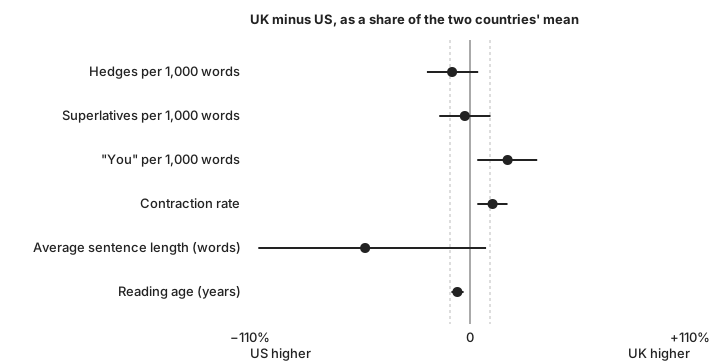
Pre-registered hypotheses and results
| Hypothesis | Result | UK brands | US brands | Difference (95% interval; % of mean) |
|---|---|---|---|---|
| H1: UK brands hedge more | No clear difference | 4.35 per 1,000 words | 4.54 per 1,000 words | −0.41 (95% interval −1.00 to +0.18; −9%) |
| H2: US brands use more superlatives | No clear difference | 2.25 per 1,000 words | 2.20 per 1,000 words | −0.06 (95% interval −0.34 to +0.23; −3%) |
| H3: US brands say "you" more | No clear difference | 25.3 per 1,000 words | 20.8 per 1,000 words | +4.4 (95% interval +0.8 to +7.9; +19%) |
| H4: US brands contract more (less formal) | Opposite of expected | 68% | 61% | +7 percentage points (95% interval +2 percentage points to +12 percentage points; +11%) |
| H5: Sentence length differs | No clear difference | 13.6 words | 21.5 words | −9.7 (95% interval −30.4 to +1.1; −52%) |
| H6: Reading age differs | No clear difference | 15.7 years | 16.8 years | −1.0 (95% interval −1.5 to −0.5; −6%) |
Checks
Reported, not tested. Each repeats the main comparison with one change; the cells give the difference as a percentage of the two countries' mean, with its 95% interval.
| Check | Hedges per 1,000 words | Superlatives per 1,000 words | "You" per 1,000 words | Contraction rate | Average sentence length (words) | Reading age (years) |
|---|---|---|---|---|---|---|
| Main test | −9% (−22 to 4) | −3% (−15 to 10) | +19% (4 to 34) | +11% (4 to 19) | −52% (−106 to 8) | −6% (−9 to −3) |
| Software brands left out | −11% (−23 to 3) | −2% (−16 to 11) | +17% (2 to 33) | +12% (4 to 20) | −55% (−109 to 8) | −6% (−10 to −3) |
| UK brands writing American kept in | −8% (−20 to 3) | 0% (−12 to 12) | +17% (3 to 31) | +11% (5 to 18) | −48% (−100 to 7) | −6% (−9 to −3) |
| Blog posts only | −7% (−20 to 5) | +4% (−9 to 18) | +14% (2 to 26) | +12% (5 to 20) | +7% (1 to 12) | −6% (−9 to −2) |
| Press releases and announcements only | +10% (−12 to 32) | −12% (−27 to 5) | +50% (15 to 78) | +9% (−2 to 20) | −94% (−147 to 9) | −7% (−10 to −4) |
| Pages dated before 2023 | −12% (−31 to 7) | −13% (−31 to 7) | −4% (−37 to 30) | −4% (−16 to 7) | +3% (−5 to 10) | −4% (−8 to 1) |
| Pages dated 2023 on | −21% (−38 to −4) | −1% (−17 to 14) | +1% (−20 to 22) | +7% (−2 to 15) | +4% (−1 to 10) | −5% (−9 to −1) |
Hedging without "may"
"May" is the most frequent hedge, and it also carries legal and permission senses ("rates may vary", "you may cancel"), which regulated sectors use heavily. Without it, the sector-matched difference (UK minus US) is +0.53 per 1,000 words (95% interval +0.15 to +0.90; +18%). This is a check, reported and not tested; H1 is decided on all 27 hedges, as pre-registered.
Sentence length: one brand's measurement artifact (post-hoc check)
Not pre-registered; added after the full run, and it changes no result above. One US brand, walmart.com, has a mean sentence length of 827 words, because one very long page is split into only a handful of sentences by the sentence splitter. That is an artifact of measurement, not a style, and every other tested brand averages between about 7 and 22 words. That one brand lifts the US average in the table above to 21.5 words and widens the interval.
Repeating the same test without it: UK 13.6 words, US 13.2 words; difference +0.5 (95% interval −0.1 to +1.2; +4%). Still no clear difference. Telling the countries apart on all six measures without it: AUC 0.54 (95% interval 0.50 to 0.58), still not better than chance.
By sector
Exploratory. Few brands per sector, so the intervals are wide. Cells give the UK minus US difference as a percentage of the two countries' mean.
| Sector | Brands (UK, US) | Hedges per 1,000 words | Superlatives per 1,000 words | "You" per 1,000 words | Contraction rate | Average sentence length (words) | Reading age (years) |
|---|---|---|---|---|---|---|---|
| bank | 16, 18 | −44% | +6% | −10% | +11% | +5% | −5% |
| charity | 8, 10 | +27% | −17% | +75% | +6% | −7% | −11% |
| energy | 10, 12 | +43% | +5% | +45% | +22% | +9% | −10% |
| fashion | 6, 4 | −49% | −26% | −19% | −14% | +4% | +1% |
| food | 5, 6 | −35% | −61% | +65% | +34% | −15% | −17% |
| grocery | 7, 6 | −1% | +36% | −70% | −11% | −162% | +5% |
| insurance | 10, 9 | −15% | −3% | +15% | +13% | +14% | −6% |
| software | 3, 16 | +28% | −7% | +38% | +3% | +6% | −4% |
| telecom | 13, 11 | +3% | +5% | +12% | +11% | +9% | −5% |
| travel | 5, 6 | +35% | −22% | +122% | +27% | −11% | −13% |
UK-listed brands that write American
13 brands in the UK corpus used American spelling for more than half of the words that have a British and an American form (all of them software companies). They are left out of the main test and kept in one check: airtable.com, asana.com, canva.com, clickup.com, figma.com, hubspot.com, intercom.com, mailchimp.com, miro.com, monday.com, notion.com, sage.com, slack.com.
Limitations
- Averages over brands hide wide spread within each country.
- Both corpora are blogs, press releases and announcements from large, well-known brands; small businesses may differ.
- Hedges and superlatives are counted from fixed word lists, so a word used in another sense is still counted ("could" in a question, "best" in a product name at the start of a sentence).
- Regulated sectors carry legal wording ("may", "do not") that moves hedging and formality; the sector matching compares like with like, and the check without "may" shows how much it matters.
- Sentence length depends on the sentence splitter; a page it cannot split (very long, unpunctuated) gives an extreme value. One US brand is affected; the post-hoc check above shows it changes no result.
- Live pages span many years, and the two countries' date mix differs; the dated checks address this.
- Some sectors have few brands on one side (the smallest has 3).
Competing interests
ScriptGrain sells writing-voice measurement and generation, and the analyst builds it. The hypotheses, word lists, rules and tests were committed to ScriptGrain's research repository (https://github.com/StovBuilds/scriptgrain-research) before the full measurement, every result is reported whether it matched the expectation or not, and the data and scripts are public.
Reproducing this
- Pre-registration and scripts: docs/research/sgr-029-preregistration.md and scripts/experiments/sgr-029/ in ScriptGrain's research repository (lexicons.mjs holds the word lists, measure.mjs the counting, run.mjs the analysis, write-entry.mjs builds this page from the summary).
- Only counts are published; no brand's text is reproduced.
Data
- Brands: pages, words and the six measures (CSV) (csv)
- Summary: hypotheses, intervals, separability, checks, sectors and word counts (JSON) (json)
- Post-hoc check: sentence length and separability without one outlier brand (JSON) (json)
Released under CC BY 4.0: free to reuse, including commercially, with credit to ScriptGrain and a link to this page.
Citations
- ScriptGrain (2026). Do brands in the same sector sound the same? (SGR-009)
- ScriptGrain (2026). What reading age do UK brands write for? (SGR-023)
- ScriptGrain (2026). How do UK brands write? (SGR-010)
How to cite
ScriptGrain (2026). Do UK and US brands write differently? Hedging, superlatives, "you", formality, sentence length and reading age, measured (Study SGR-029, conducted 17 November 2026). Dataset licensed CC BY 4.0. https://scriptgrain.com/research/do-uk-and-us-brands-write-differently
About the analyst
Jack Stovell has worked in finance and data for more than twelve years, building management reporting, forecasting and profitability models for advertising agencies and tech scale-ups, from SQL and Power BI reporting to board-level analysis. Since 2016 he has run Adapt Progress Evolve, an applied AI studio, where he builds and operates AI systems and data products: ScriptGrain's measurement of writing voice across 45 attributes, UK Spend, which brings 16.7 million rows of UK council spending into one queryable dataset, and more than thirty AI agents running in production. He designs ScriptGrain's studies and is accountable for every number in them.