Is ChatGPT Americanising British writing? American spelling and phrasing in UK brand writing before and after November 2022
SGR-028, conducted 2026-11-12. Analyst: Jack Stovell, founder, ScriptGrain.
Question: Since ChatGPT launched on 30 November 2022, has British brand writing moved towards American spelling and American business phrasing, and by more than American brand writing's own drift?
Summary
Background. People say AI tools are pushing British writing towards American English: "organize" for "organise", "reach out" for "get in touch". Spelling is the easy part to measure and the easy part to get wrong, because Oxford spelling ("organize" with "colour") is legitimate British usage. So we measured spelling and phrasing separately, and spelling twice.
What we did. We fixed four hypotheses before the full measurement. From our corpus of UK brands' blogs, press releases and announcements, we took every brand with at least 30 dated pages before December 2022 and 30 from 2023 on, and compared each brand only with itself. Brands that wrote American before ChatGPT were set aside (4). We counted a closed list of 168 spelling pairs and 30 American business phrases in code, and ran the same measurement on 39 American brands as a control. One rule was added after the plan was frozen, because the first run failed its instrument check: pages labelled for another market were dropped from both corpora. The note below explains what happened and why.
What we found. American spellings were 1.93% of the words that have a British and an American form before and 2.42% after, counting only words where Oxford spelling cannot blur the line (change 0.49 pp (95% interval −1.01 to 2.43), 9 of 27 brands up). American business phrases such as "reach out" and "going forward" went from 0.098 to 0.136 per 1,000 words (change +0.038 (95% interval 0.013 to 0.062), 21 of 29 brands up). American brands' own phrase rate changed by −0.154 (95% interval −0.446 to 0.047) per 1,000 words over the same periods (39 brands).
What it means. We found no clear shift towards American spelling or American business phrasing in UK brand writing after ChatGPT. A change in the ChatGPT era is a correlation with that era, not evidence that any page was written by AI: American phrasing also spreads through global templates, US parent companies, agencies and hiring.
Key numbers
- American spelling in UK brand writing went from 1.93% to 2.42% of words with a British and an American form, before and after November 2022, within the same 27 brands (Oxford-proof words; change 0.49 pp (95% interval −1.01 to 2.43); ScriptGrain, 2026).
- American business phrases in UK brand writing went from 0.098 to 0.136 per 1,000 words within the same 29 brands (change +0.038 (95% interval 0.013 to 0.062)).
- In the same periods American brands' phrase rate changed by −0.154 (95% interval −0.446 to 0.047) per 1,000 words (39 brands); the UK change minus the US change was +0.192 (95% interval −0.013 to 0.467).
- The study measured 5,412 dated pages (7,256,322 words) from 29 UK brands and 2,772 pages from 39 US brands.
Sample
UK brands from ScriptGrain's brand corpus (blogs, press releases and announcements; live pages fetched in October 2026 and archived pages from the Wayback Machine) with at least 30 dated pages before December 2022 and 30 from 2023 on: 33 brands, of which 4 wrote American before ChatGPT and were set aside. Control: 39 American brands from ScriptGrain's US brand corpus with at least 10 dated pages on each side.
- A UK brand in ScriptGrain's brand corpus
- At least 30 dated pages before December 2022 and 30 from January 2023
- At least 30 spelling-pair words in each period, for the spelling measures
- An American spelling share of 50% or less before ChatGPT (the house-style guard)
Method
Corpus: ScriptGrain's UK brand corpus (blogs, press releases and announcements from UK brands in ten sectors) and US brand corpus (the American counterpart, matched by sector). Every page was measured in code; no language model read or scored any page.
Dating: the page's own published date (meta tags, structured data, the URL or a date in the text); for archived pages, the month of the capture, which is an upper bound on publication.
Cleaning: markdown reduced to plain text; tables, code, block quotes, links, email addresses and quoted speech removed; the brand's own name and any capitalised word that does not start a sentence skipped (proper names, product names, Title Case headings).
Pre-registration: the hypotheses, word lists, periods, eligibility rules and tests were committed to ScriptGrain's research repository before the full measurement (docs/research/sgr-028-preregistration.md). The full run was done on the day before publication. It failed its instrument check and was run again the same day with one rule added after the freeze (see "Deviation from the pre-registration").
Tests: mean within-brand change with a 95% interval from 10,000 bootstrap resamples of brands; Wilcoxon signed-rank test and the share of brands that moved up as secondary checks. H3 compares the UK change with the US change, the two countries resampled separately.
Variables measured
- American spelling share (all pairs, Oxford-proof pairs, -ize pairs)
- American business phrases per 1,000 words
- British markers per 1,000 words (whilst, amongst, learnt, towards; descriptive only)
What each measure means
- Before and after
- Before: pages dated up to November 2022 (ChatGPT launched on 30 November 2022), including archived copies from the Wayback Machine. After: live pages dated January 2023 onwards. December 2022 is a buffer and left out, as are undated pages and pages dated only by a last-modified stamp.
- American spelling share
- American forms divided by American plus British forms, over a closed, pre-registered list of 168 word pairs (2,979 word forms), such as colour and color or organise and organize. Pairs with a second meaning are excluded (licence and license, practise and practice, programme and program, meter and metre, among others). Brand names, capitalised mid-sentence words, quotations and links are skipped.
- Oxford-proof words
- The 70 pairs where Oxford spelling and American spelling differ, such as colour and color or centre and center. Oxford spelling writes -ize but keeps -our and -re, so it is legitimate British usage; the -ize pairs are reported separately and are not in the headline test.
- American business phrases
- Uses per 1,000 words of 30 pre-registered phrases and words: reach out, going forward, touch base, circle back, deep dive, low-hanging fruit, game changer, move the needle, pain point, best in class, learnings, gotten, awesome, vacation, cell phone, zip code and others, plus "leverage" used as a verb.
- Within-brand change
- For each brand, the value after minus the value before; then the mean of those changes, each brand counting once, so a brand that published more after cannot dominate.
- 95% interval
- From 10,000 bootstrap resamples of brands (fixed seed). A hypothesis passes only if the mean change reaches its pre-registered size, the interval's lower bound is above zero and at least 60% of brands moved up.
Findings
- H1 (not supported): American spelling, Oxford-proof words (1.93% to 2.42%; change 0.49 pp (95% interval −1.01 to 2.43)): 9 of 27 brands moved up. The pre-registered bar was +0.25 percentage points with an interval above zero and at least 60% of brands up. Wilcoxon p 0.958.
- H1b (not supported): American spelling, all pairs (2.27% to 2.21%; change 0.06 pp (95% interval −1.21 to 1.13)): Includes the -ize pairs, which Oxford spelling also uses. The -ize pairs alone: 0.40 pp (95% interval −1.68 to 0.86) (28 brands).
- H2 (not supported): American business phrases (0.098 to 0.136 per 1,000 words; change +0.038 (95% interval 0.013 to 0.062)): 21 of 29 brands moved up. The pre-registered bar was +0.10 per 1,000 words with an interval above zero and at least 60% of brands up. The most frequent phrases after November 2022: leverage (verb) (0.059), deep dive (0.017), reach out (0.014), going forward (0.013), best in class (0.007).
- H3 (not supported): UK moved more than the US (UK minus US phrase change +0.192 (95% interval −0.013 to 0.467)): UK 0.038 against US −0.154 per 1,000 words. The same comparison on Oxford-proof spelling: +1.05 pp (95% interval −1.56 to 4.52).
What this study does not show
- That any page, or any brand, used AI to write. The counts show style in the ChatGPT era, not who or what wrote a page.
- That voice measurement, ScriptGrain's or anyone's, can tell whether a text was written by AI. Nothing in this study tests that.
- Why any change happened. US parent companies, global templates, agencies, new staff and style guides can each move these numbers.
- Anything about British writing outside brand blogs, press releases and announcements.
Deviation from the pre-registration
This study did not run exactly as pre-registered. The frozen plan said the run stops, and nothing is published, if American brands do not read as American: across the US control brands, at least 98% of the words with a British and an American form had to use the American form. On 12 November 2026 the first full run failed that check. The pooled American share across 37 US brands was 94.8% (99.4% before December 2022, 93.2% from 2023). A few brands read mostly British after 2022: habitat.org 22%, stripe.com 30%, expedia.com 63% American.
We read those pages. The word list was not misreading anything; the US corpus held pages written for other markets. Stripe serves its British edition at the same addresses, and 103 of its 119 pages declared British English. Habitat for Humanity's corpus included its Europe, Asia-Pacific and Latin America sections and a report by Habitat for Humanity Great Britain. Expedia's newsroom included releases issued from London.
So we added one rule, after the plan was frozen and after the failed run, and wrote it into the pre-registration's Deviations section before running again: a page labelled for another market is dropped, by its declared language (for example British English in the US corpus) or by a locale section in its address (such as /en-gb/, /emea/ or /intl/). The rule applies to both countries alike. It removed 430 US pages and 2,161 UK pages (most of those UK pages declared American English). Brand eligibility was counted after the rule, no page was removed by hand, and the 98% floor was not changed.
With the rule, the check passed: 98.6% across 33 US brands (99.4% before, 98.2% after). The rule cannot catch pages that are not labelled, such as the Habitat Great Britain report and Expedia's London releases, which remain in the control.
The rule changed one result. On the original corpus H3 (UK phrase change minus US phrase change) would have passed, +0.191 (95% interval 0.007 to 0.439), but that run had failed its instrument check. With the rule it does not pass: +0.192 (95% interval −0.013 to 0.467). It also does not pass when the UK corpus is left exactly as frozen and only the control is filtered (+0.198 (95% interval −0.008 to 0.476)), so the change comes from removing other markets' pages from the US control, not from the UK pages the rule removed. H1, H1b and H2 are not supported either way. The original rule, the failed run's numbers and the new rule are all in the pre-registration and the downloads below.
What changed, within the same brands
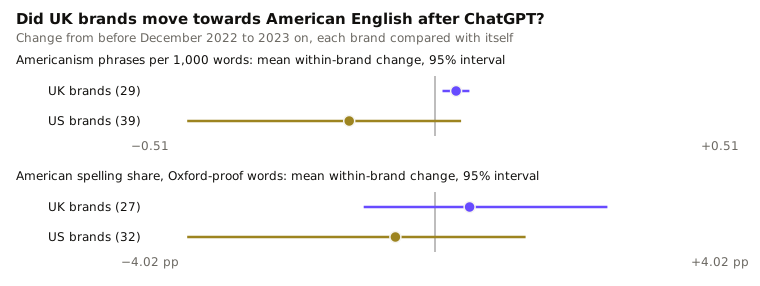
Pre-registered hypotheses and results
| Hypothesis | Result | Change (95% interval) |
|---|---|---|
| H1: American spelling rose (Oxford-proof words) | Not supported | 0.49 pp (95% interval −1.01 to 2.43) |
| H1b: American spelling rose (all pairs) | Not supported | 0.06 pp (95% interval −1.21 to 1.13) |
| H2: American business phrases rose | Not supported | +0.038 (95% interval 0.013 to 0.062) per 1,000 words |
| H3: UK moved towards the US more than the US moved | Not supported | +0.192 (95% interval −0.013 to 0.467) per 1,000 words |
Checks
Reported, not tested. Each repeats the main comparison with one change.
| Check | Spelling, Oxford-proof (95% interval) | Phrases per 1,000 words (95% interval) | Brands |
|---|---|---|---|
| Main test | 0.49 pp (95% interval −1.01 to 2.43) | +0.038 (95% interval 0.013 to 0.062) | 29 |
| Before = live pages only (no archived copies) | 0.44 pp (95% interval −1.95 to 0.85) | +0.049 (95% interval 0.015 to 0.083) | 28 |
| After = 2024 onwards only | +0.59 pp (95% interval −0.98 to 2.61) | +0.045 (95% interval 0.018 to 0.073) | 29 |
| Software brands left out | +0.51 pp (95% interval −1.04 to 2.53) | +0.036 (95% interval 0.011 to 0.061) | 28 |
| UK corpus without the locale rule (as frozen); US control with it | +0.60 pp (95% interval −0.75 to 2.44) | +0.044 (95% interval 0.019 to 0.067) | 30 |
| US control, brands with 30+ pages each side | 0.10 pp (95% interval −1.40 to 1.47) | −0.065 (95% interval −0.298 to 0.173) | 10 |
By sector
Exploratory. Few brands per sector, so the intervals are wide.
| Sector | Brands | Spelling, Oxford-proof | Phrases per 1,000 words |
|---|---|---|---|
| bank | 8 | −1.41 pp (95% interval −3.70 to −0.09) | +0.046 (95% interval −0.002 to 0.090) |
| charity | 6 | +1.63 pp (95% interval 0.19 to 3.11) | +0.027 (95% interval −0.022 to 0.075) |
| energy | 4 | −2.07 pp (95% interval −5.38 to −0.05) | −0.015 (95% interval −0.031 to 0.001) |
| food | 1 | n/a | not enough data |
| insurance | 6 | +2.76 pp (95% interval −1.19 to 9.67) | +0.057 (95% interval 0.022 to 0.098) |
| software | 1 | not enough data | not enough data |
| telecom | 3 | +1.65 pp (95% interval 0.28 to 4.24) | +0.055 (95% interval −0.087 to 0.166) |
Brands that wrote American before ChatGPT
4 brands in the UK corpus already used American spelling for more than half of the paired words before December 2022 (mostly US-headquartered software companies with UK sites). They are left out of every UK test: airtable.com, asana.com, figma.com, mailchimp.com.
The measuring instrument
As a check on the word list, American brands should read as American. Across the 33 US control brands, 98.6% of paired words used the American form (pre-registered floor 98%), after the locale rule described under "Deviation from the pre-registration". Before the rule it was 94.8% and the check failed. The British forms that remain are genuine British spellings, not misread words.
Limitations
- The study deviates from its pre-registration: after the first full run failed the instrument check, a rule dropping pages labelled for another market was added to both corpora (430 US and 2,161 UK pages removed). See "Deviation from the pre-registration".
- A change in the ChatGPT era is a correlation with that era. It is not evidence that any text was written by AI.
- Oxford spelling is legitimate British usage. The -ize spellings are not errors and are not in the headline test.
- Before-period text is mostly archived Wayback copies and after-period text mostly live pages, so the extraction differs; the live-only check and the US control address this.
- Dates come from page metadata, the URL and dates in the text; a date in the text is a best guess.
- Brand blogs and press pages are written by many people, sometimes by agencies.
- Skipping capitalised words loses some real words in Title Case headings, equally in both periods.
- Phrase counts are low, about one per 10,000 words, so a few brands can move the totals; this is why the test is per brand and needs most brands to move.
- The US control has fewer brands (39) than the UK panel and needed only 10 dated pages each side to be included.
Competing interests
ScriptGrain sells writing-voice measurement and generation, and the analyst builds it. The hypotheses, word lists, periods and tests were committed to ScriptGrain's research repository (https://github.com/StovBuilds/scriptgrain-research) before the full measurement, every result is reported whether it passed or failed, and the data and scripts are public.
Reproducing this
- Pre-registration and scripts: docs/research/sgr-028-preregistration.md and scripts/experiments/sgr-028/ in ScriptGrain's research repository (terms.mjs holds the word lists, measure.mjs the counting, run.mjs the analysis, write-entry.mjs builds this page from the summary).
- Only counts are published; no brand's text is reproduced.
Data
- Brand by period: pages, words, spelling shares and phrase rates (CSV) (csv)
- Summary: hypotheses, intervals, checks, phrase and marker counts (JSON) (json)
- The failed first run, before the locale rule: summary (JSON) (json)
- The failed first run, before the locale rule: brand by period (CSV) (csv)
- Check: UK corpus as frozen, US control with the locale rule: summary (JSON) (json)
Released under CC BY 4.0: free to reuse, including commercially, with credit to ScriptGrain and a link to this page.
Citations
- ScriptGrain (2026). Did brand writing change after ChatGPT? (SGR-011)
- Oxford spelling, Oxford English Dictionary
How to cite
ScriptGrain (2026). Is ChatGPT Americanising British writing? American spelling and phrasing in UK brand writing before and after November 2022 (Study SGR-028, conducted 12 November 2026). Dataset licensed CC BY 4.0. https://scriptgrain.com/research/is-chatgpt-americanising-british-writing
About the analyst
Jack Stovell has worked in finance and data for more than twelve years, building management reporting, forecasting and profitability models for advertising agencies and tech scale-ups, from SQL and Power BI reporting to board-level analysis. Since 2016 he has run Adapt Progress Evolve, an applied AI studio, where he builds and operates AI systems and data products: ScriptGrain's measurement of writing voice across 45 attributes, UK Spend, which brings 16.7 million rows of UK council spending into one queryable dataset, and more than thirty AI agents running in production. He designs ScriptGrain's studies and is accountable for every number in them.