Which classic authors write most like an AI? 1,129 authors, 6,293 books, measured
SGR-021, conducted 2026-10-20. Analyst: Jack Stovell, founder, ScriptGrain.
Question: Which human writers, long before any language model, already used the words and habits now called AI-isms, and how much? Which of those words lived in which authors and eras?
Summary
Background. Word lists of ChatGPT's supposed tells, such as delve, tapestry and realm, are mocked as machine habits. Those words come from somewhere. This study asks which human writers, in public-domain books written long before 2022, already used them, and how much.
What we did. Before measuring anything we fixed an inclusion rule, four hypotheses and the outputs. The set is every author in Project Gutenberg's public-domain English catalogue who meets the inclusion rule, not a curated canon: every English-language author whom Wikidata confirms and who has at least three books of 15,000 words or more and 100,000 words in all: 1,129 authors, 6,293 books, 459.4 million words, up to eight books each. For every book we counted uses of the frozen AI-ism lists per 1,000 words and ranked authors with 95% intervals over their own books.
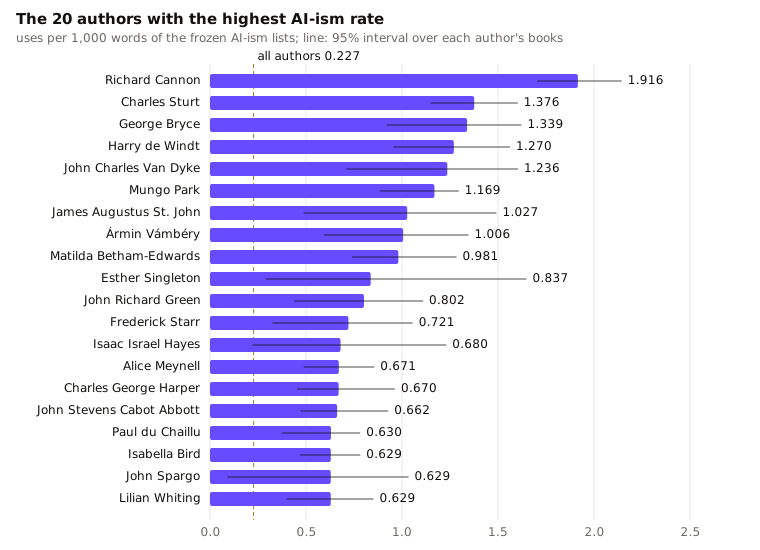
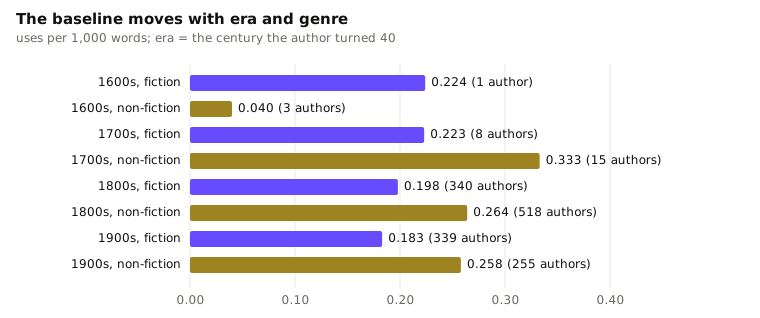
What we found. Richard Cannon (1779 to 1865) ranked first at 1.916 uses per 1,000 words (interval 1.703 to 2.144), against 0.227 for the whole corpus. 19 of the top 20 are represented here only by non-fiction (by their titles, mostly travel, exploration and history). 9 of the top 10 stay in the top 10 when each author's top book (the one whose removal lowers their rate most) is left out. Non-fiction used the lists more than fiction (0.263 against 0.191 per 1,000 words), and the ranking held when dialogue was taken out (Spearman 0.97).
What it means. These are the habits of human writers, measured as word counts. They show that the words on the lists were ordinary, often older, English long before language models; they do not show that any author influenced a model, and they cannot tell whether any text was written by AI.
Key numbers
- Across 1,129 English-language authors and 6,293 public-domain books, the AI-ism lists appear 0.227 times per 1,000 words (ScriptGrain, 2026).
- Richard Cannon ranks first at 1.916 uses per 1,000 words (95% interval 1.703 to 2.144) across 8 books; Charles Sturt is second at 1.376 and George Bryce third at 1.339.
- 140 of 1,129 authors have an interval entirely above the corpus rate.
- Non-fiction books use the lists 0.263 times per 1,000 words against 0.191 for fiction (difference +0.072, 95% interval +0.055 to +0.089).
- Authors who turned 40 in the 1900s average 0.206 against 0.242 for the 1800s (difference −0.036, 95% interval −0.052 to −0.019).
Sample
The set is plainly "authors in Project Gutenberg's public-domain English catalogue who meet the inclusion rule", not a curated canon. It is made of English-language books (catalogue snapshot of 4 October 2026) by authors that Wikidata records as English-language writers with Gutenberg IDs and known birth and death years. An author is in if their midlife year (birth plus 40) is between 1650 and 1949 and they have at least three eligible books of 15,000 words or more; up to eight books each, chosen in a seeded random order. 1,129 authors, 6,293 books and 459.4 million words: 3 authors from the 1600s, 16 from the 1700s, 660 from the 1800s and 450 from the 1900s by midlife year, 3,324 fiction books and 2,969 non-fiction.
- English-language author per Wikidata, with a Project Gutenberg author ID and birth and death years, turning 40 between 1650 and 1949
- At least three eligible books of 15,000 words or more, and at least 100,000 words in all
- Up to eight books per author, drawn in a seeded random order
Method
Pre-registration: the inclusion rule, word lists, hypotheses and outputs were committed to the public repository before any book was measured (docs/research/sgr-021-preregistration.md). The panel is whatever the rules produce, with no hand edits.
Measurement: each whole book is scanned with the frozen word lists from SGR-007 by deterministic code; a book's value is its uses divided by its words. No language model reads or scores any text.
Ranking: authors ordered by total uses over total words, with a 95% interval from 10,000 resamples of their books, and re-ranked without their top book, against peers of the same era and genre, and on narration only.
H1 to H4: pre-registered tests with 95% bootstrap intervals over authors (10,000 resamples).
Variables measured
- AI-ism uses per 1,000 words
- AI-ism uses per 1,000 words of narration
- Uses of each listed word
- Share of words in dialogue
- AI-tell pattern density per 1,000 words (secondary)
What each measure means
- AI-ism rate
- Uses per 1,000 words of the frozen word lists (OLD, CALLED_OUT and MARKETING from SGR-007), each occurrence counted once. Lists include delve, tapestry, realm, embark, journey and landscape. No list says a text was written by AI.
- 95% interval
- From 10,000 resamples of an author's books with replacement. A wide interval means the author's books disagree.
- Without the top book
- An author's lowest rate after leaving out any one of their books: a guard against a single odd book.
- Versus peers
- An author's uses divided by the uses expected from other authors' books of the same genre in the same era. 1.0 is average for that era and genre.
- Era
- The century in which the author turned 40. Gutenberg dates e-texts, not first editions, so books cannot be dated more precisely.
- Earliest strong home
- The earliest decade (by the year authors turned 40) in which a word's rate is at least twice its corpus rate, with at least 10 uses by at least 2 authors.
- Narration
- A book's text with everything inside paired double quotation marks removed, so dialogue does not count.
Findings
- The ranking: who used the lists most (Richard Cannon 1.916, Charles Sturt 1.376, George Bryce 1.339 uses per 1,000 words): The corpus rate is 0.227 and the middle author's is 0.196. The next in the top 10 are Harry de Windt, John Charles Van Dyke, Mungo Park, James Augustus St. John, Ármin Vámbéry, Matilda Betham-Edwards and Esther Singleton. The chart shows intervals over each author's books; 4 of the top 20 get more than half their uses from a single book. Most of Richard Cannon's rate is one listed word: "embark" and its forms, 1.826 of the 1.916 uses per 1,000 words; the books are regimental histories, where regiments embark for campaigns.
- Robust to one odd book (9 of the top 10 stay in the top 10 without their top book): 15 of the top 20 by rate are also in the top 20 once each author's top book is left out, and 14 are in the top 20 against peers of their era and genre. The robust top 10 is Richard Cannon, Charles Sturt, George Bryce, Harry de Windt, John Charles Van Dyke, Mungo Park, James Augustus St. John, Ármin Vámbéry, Matilda Betham-Edwards and John Richard Green.
- H1 (supported): non-fiction against fiction (+0.072 uses per 1,000 words; 95% interval +0.055 to +0.089): Non-fiction 0.263, fiction 0.191. Genre is the catalogue's label, and many authors wrote both.
- H2 (supported, a difference): 1900s against 1800s authors (−0.036 per 1,000 words; 95% interval −0.052 to −0.019): Mean author rate 0.206 for 450 authors whose midlife year was in the 1900s and 0.242 for 660 in the 1800s. We predicted no direction. Era and genre are both in the peers ranking, whose top 10 is Richard Cannon, Charles Sturt, George Bryce, Harry de Windt, John Charles Van Dyke, Mungo Park, James Augustus St. John, Ármin Vámbéry, John Bunyan and Matilda Betham-Edwards. Where an era has few authors the peers baseline is thin (the 1600s have 3), so John Bunyan (rank 737 by rate, ratio 3.76, interval 0.41 to 8.31) enters that top 10 with a wide interval.
- H3 (supported): not a dialogue artefact (Spearman 0.97; 95% interval 0.96 to 0.97): The bar was 0.9. 16 of the top 20 are also in the narration-only top 20. Exploratory: the author rate correlates with dialogue share at Spearman −0.19.
- H4 (supported): a stable habit of the author (ICC 0.43; 95% interval 0.33 to 0.54): The share of the variation in book-level rates that is between authors rather than between an author's own books. The bar was a lower bound above 0.25.
- Where the listed words lived (38 listed words, each with a top author and an earliest strong home): "delve": 419 uses, 0.001 per 1,000 words, used most by Ernest William Hornung (0.034); no decade at twice the corpus rate with enough uses (peak: 1930s, 1.99 times). "tapestry": 2,155 uses, 0.005 per 1,000 words, used most by Esther Singleton (0.272); earliest strong home: authors who turned 40 in the 1800s (2.08 times the corpus rate). "realm": 7,894 uses, 0.017 per 1,000 words, used most by John Richard Green (0.702); no decade at twice the corpus rate with enough uses (peak: 1810s, 1.62 times). "embark": 8,605 uses, 0.019 per 1,000 words, used most by Richard Cannon (1.826); earliest strong home: authors who turned 40 in the 1750s (2.85 times the corpus rate). "journey": 42,874 uses, 0.093 per 1,000 words, used most by George Bryce (1.161); no decade at twice the corpus rate with enough uses (peak: 1830s, 1.60 times). "landscape": 10,335 uses, 0.022 per 1,000 words, used most by John Charles Van Dyke (1.062); no decade at twice the corpus rate with enough uses (peak: 1800s, 1.24 times).
What this study does not show
- That any author sounds like an AI, or that any model learned from any author. The study counts words in human books; it shows no causal link.
- That voice measurement, ScriptGrain's or anyone's, can tell whether a text was written by AI. Nothing in this study tests that. It does not establish that voice measurement can tell whether a text was written by AI.
- When a book was first published. Gutenberg dates e-texts, so eras are by the year the author turned 40.
- Which authors are best or worst. The word lists include ordinary English words with older senses (realm, journey, landscape); a high rate says the author used them, not how well.
- A canon. Only authors that Wikidata and the Gutenberg catalogue let us match are included, and the public-domain record under-represents women and writers outside Britain and America.
The top 20
The baseline moves with era and genre
Pre-registered hypotheses and results
| Hypothesis | Result | Test |
|---|---|---|
| H1: non-fiction books use the lists more than fiction | Supported | +0.072 (+0.055 to +0.089) |
| H2: authors from the 1900s differ from authors from the 1800s | Supported | −0.036 (−0.052 to −0.019) |
| H3: the ranking holds with dialogue removed (Spearman at least 0.9) | Supported | 0.97 (0.96 to 0.97) |
| H4: book rates cluster within authors (ICC lower bound above 0.25) | Supported | 0.43 (0.33 to 0.54) |
The top 20 authors
| Rank | Author | Books | Per 1,000 words | 95% interval | Without top book | Versus peers |
|---|---|---|---|---|---|---|
| 1 | Richard Cannon (1779 to 1865) | 8 | 1.916 | 1.703 to 2.144 | 1.845 (rank 1) | 7.31 (rank 1) |
| 2 | Charles Sturt (1795 to 1869) | 3 | 1.376 | 1.148 to 1.603 | 1.259 (rank 2) | 5.26 (rank 2) |
| 3 | George Bryce (1844 to 1931) | 4 | 1.339 | 0.920 to 1.622 | 1.176 (rank 3) | 5.11 (rank 3) |
| 4 | Harry de Windt (1856 to 1933) | 4 | 1.270 | 0.956 to 1.562 | 1.092 (rank 4) | 4.84 (rank 4) |
| 5 | John Charles Van Dyke (1856 to 1932) | 4 | 1.236 | 0.710 to 1.604 | 1.020 (rank 5) | 4.70 (rank 5) |
| 6 | Mungo Park (1771 to 1806) | 3 | 1.169 | 0.884 to 1.296 | 0.961 (rank 6) | 4.44 (rank 6) |
| 7 | James Augustus St. John (1795 to 1875) | 4 | 1.027 | 0.488 to 1.492 | 0.871 (rank 7) | 3.91 (rank 7) |
| 8 | Ármin Vámbéry (1832 to 1913) | 4 | 1.006 | 0.593 to 1.346 | 0.856 (rank 8) | 3.83 (rank 8) |
| 9 | Matilda Betham-Edwards (1836 to 1919) | 5 | 0.981 | 0.739 to 1.284 | 0.841 (rank 9) | 3.73 (rank 10) |
| 10 | Esther Singleton (1865 to 1930) | 7 | 0.837 | 0.290 to 1.648 | 0.505 (rank 28) | 3.33 (rank 11) |
| 11 | John Richard Green (1837 to 1883) | 8 | 0.802 | 0.438 to 1.110 | 0.699 (rank 10) | 3.05 (rank 12) |
| 12 | Frederick Starr (1858 to 1933) | 7 | 0.721 | 0.325 to 1.056 | 0.504 (rank 29) | 2.74 (rank 15) |
| 13 | Isaac Israel Hayes (1832 to 1881) | 3 | 0.680 | 0.221 to 1.231 | 0.238 (rank 246) | 2.76 (rank 14) |
| 14 | Alice Meynell (1847 to 1922) | 8 | 0.671 | 0.488 to 0.856 | 0.630 (rank 11) | 2.55 (rank 22) |
| 15 | Charles George Harper (1863 to 1943) | 8 | 0.670 | 0.453 to 0.963 | 0.524 (rank 23) | 2.64 (rank 17) |
| 16 | John Stevens Cabot Abbott (1805 to 1877) | 8 | 0.662 | 0.472 to 0.928 | 0.556 (rank 15) | 2.52 (rank 24) |
| 17 | Paul du Chaillu (1835 to 1903) | 7 | 0.630 | 0.374 to 0.782 | 0.552 (rank 18) | 2.39 (rank 30) |
| 18 | Isabella Bird (1831 to 1904) | 8 | 0.629 | 0.468 to 0.783 | 0.571 (rank 14) | 2.40 (rank 29) |
| 19 | John Spargo (1876 to 1966) | 5 | 0.629 | 0.091 to 1.034 | 0.376 (rank 58) | 2.46 (rank 26) |
| 20 | Lilian Whiting (1847 to 1942) | 5 | 0.629 | 0.399 to 0.852 | 0.541 (rank 20) | 2.39 (rank 32) |
Every listed word
| Word | Uses | Per 1,000 words | Used most by | Earliest strong home | Peak decade |
|---|---|---|---|---|---|
| journey | 42,874 | 0.093 | George Bryce | none | 1830s (1.60 times) |
| landscape | 10,335 | 0.022 | John Charles Van Dyke | none | 1800s (1.24 times) |
| embark* | 8,605 | 0.019 | Richard Cannon | 1750s | 1760s (8.60 times) |
| elevate* | 8,410 | 0.018 | Joel Cook | 1720s | 1720s (3.45 times) |
| realm | 7,894 | 0.017 | John Richard Green | none | 1810s (1.62 times) |
| harness* | 5,349 | 0.012 | Erskine Childers | 1940s | 1940s (2.10 times) |
| unlock* | 3,911 | 0.009 | Edgar Wallace | 1940s | 1940s (2.52 times) |
| intricate* | 3,190 | 0.007 | Waldo Frank | none | 1920s (1.60 times) |
| tackle | 2,642 | 0.006 | Ralph Henry Barbour | 1910s | 1910s (2.13 times) |
| tapestry | 2,155 | 0.005 | Esther Singleton | 1800s | 1800s (2.08 times) |
| revolutionis* | 1,772 | 0.004 | John Spargo | none | 1890s (1.84 times) |
| empower* | 1,580 | 0.003 | Henry Charles Lea | 1750s | 1790s (5.90 times) |
| utilized | 1,205 | 0.003 | William James Henderson | none | 1890s (1.93 times) |
| commendable | 1,012 | 0.002 | Matthew Arnold | 1720s | 1720s (3.08 times) |
| firstly | 901 | 0.002 | L. F. L. Oppenheim | none | 1810s (1.73 times) |
| revolutioniz* | 621 | 0.001 | Frederick Jackson Turner | none | 1930s (1.65 times) |
| delve* | 419 | 0.001 | Ernest William Hornung | none | 1930s (1.99 times) |
| meticulous* | 343 | 0.001 | Katharine Elizabeth Fullerton Gerould | 1910s | 1930s (9.35 times) |
| effortless* | 241 | 0.001 | Edward Elmer Smith | 1920s | 1940s (18.62 times) |
| navigate the | 185 | 0.000 | Willis J. Abbot | none | 1850s (1.78 times) |
| facilitates | 176 | 0.000 | Joseph Collins | 1860s | 1860s (2.33 times) |
| unleash* | 161 | 0.000 | Waldo Frank | 1910s | 1930s (7.97 times) |
| cutting-edge | 137 | 0.000 | Warren K. Moorehead | 1900s | 1900s (2.41 times) |
| pivotal | 124 | 0.000 | Sutton E. Griggs | none | 1870s (1.68 times) |
| seamless* | 93 | 0.000 | n/a | none | 1870s (1.85 times) |
| showcas* | 63 | 0.000 | Joseph C. Lincoln | 1910s | 1910s (3.52 times) |
| in seconds | 36 | 0.000 | Murray Leinster | 1930s | 1930s (23.16 times) |
| streamline* | 19 | 0.000 | Murray Leinster | none | none |
| advancements | 14 | 0.000 | n/a | none | none |
| next-level | 14 | 0.000 | n/a | none | none |
| redefin* | 9 | 0.000 | n/a | none | none |
| supercharge* | 8 | 0.000 | n/a | none | none |
| transformative | 6 | 0.000 | Albert Charles Seward | none | none |
| innovative | 1 | 0.000 | n/a | none | none |
| underscores | 1 | 0.000 | n/a | none | none |
| reimagin* | 1 | 0.000 | n/a | none | none |
| at scale | 1 | 0.000 | n/a | none | none |
| game-changer | 0 | 0.000 | n/a | none | none |
Limitations
- Project Gutenberg texts come from particular editions; spelling and wording can be modernised or edited. Only words are counted, not punctuation.
- Eras are by the year the author turned 40, not the book's first publication, because the catalogue gives e-text dates.
- Genre is the catalogue's subject label, and the corpus mixes novels, essays, histories, science and sermons; the peers ranking corrects for the label, not for subject matter.
- The word lists contain ordinary English words with older senses (realm, journey, landscape, harness); a count is a count of words, never evidence that a passage is machine-like.
- Up to eight books per author, chosen at random; an author's rate rests on those books, and the interval shows how far they disagree.
- Only authors that Wikidata and the catalogue let us match; the public-domain record under-represents women and writers outside Britain and America, so the ranking describes this corpus, not writers in general.
- Correlation only: the study cannot show that any author influenced any model, or that measurement can identify AI writing.
Competing interests
ScriptGrain sells writing-voice measurement and generation, and the analyst builds it. The inclusion rule, word lists, hypotheses and outputs were fixed and published before any book was measured, nothing was re-run or selected, and the scripts are public, so the numbers can be checked without taking our word for them.
Reproducing this
- Pre-registration, Wikidata query and saved result, panel and every script: docs/research/sgr-021-preregistration.md and scripts/experiments/sgr-021/ in the ScriptGrain repository.
- Every book is named by its Project Gutenberg number in the data, so any text can be re-read and measured with the published word lists.
Data
- Every book: uses, words and rates (CSV) (csv)
- Every author: rank, interval, rank without top book, versus peers (CSV) (csv)
- Every listed word: top author and earliest strong home (CSV) (csv)
- Summary: hypotheses, baselines, rankings (JSON) (json)
Released under CC BY 4.0: free to reuse, including commercially, with credit to ScriptGrain and a link to this page.
Citations
How to cite
ScriptGrain (2026). Which classic authors write most like an AI? 1,129 authors, 6,293 books, measured (Study SGR-021, conducted 20 October 2026). Dataset licensed CC BY 4.0. https://scriptgrain.com/research/which-classic-authors-write-most-like-an-ai
About the analyst
Jack Stovell has worked in finance and data for more than twelve years, building management reporting, forecasting and profitability models for advertising agencies and tech scale-ups, from SQL and Power BI reporting to board-level analysis. Since 2016 he has run Adapt Progress Evolve, an applied AI studio, where he builds and operates AI systems and data products: ScriptGrain's measurement of writing voice across 45 attributes, UK Spend, which brings 16.7 million rows of UK council spending into one queryable dataset, and more than thirty AI agents running in production. He designs ScriptGrain's studies and is accountable for every number in them.