How do UK mobile, broadband and TV providers write? 15 brands measured against nine other sectors
SGR-015, conducted 2026-10-05. Analyst: Jack Stovell, founder, ScriptGrain.
Question: How does the writing of UK mobile, broadband and TV providers differ from other sectors' on counted habits such as sentence length, "you", contractions and AI-associated words, and how has it changed since 2015?
Summary
Background. SGR-010 measured how 117 UK brands in 10 sectors write, and SGR-011 tested whether that changed after ChatGPT. This report takes one sector, telecoms brands, and sets its writing against the other nine.
What we did. We measured 1,816 pages from 15 UK mobile, broadband and TV providers: 1,385 blog posts and 431 press releases and announcements, 493 of them from the Internet Archive. Every measure is a count made in code. Each brand counts once, however many pages it has.
What we found. Against the other nine sectors, telecoms brands wrote with more questions (4.2 against 2.9, 2nd highest of 10 sectors); more "you" (62% against 48%, 3rd highest of 10 sectors); more AI-era marketing words (1.06 against 0.88, 2nd highest of 10 sectors); more contractions (17.5 against 15.5, 3rd highest of 10 sectors). Telecoms brands' most distinctive words were "phone", "internet", "network", "devices", "sports", "device".
What it means. These are sector averages over brands. On 9 of the 12 habits the middle half of the sector's own brands spans the other sectors' average, so telecoms brands differ among themselves more than the sector differs from the rest. The report describes; it was not set up to test a hypothesis.
Key numbers
- UK telecoms brands averaged 4.2 questions per 1,000 words, against 2.9 in the other nine sectors (2nd highest of 10 sectors; ScriptGrain, 2026; 15 brands, 1,816 pages).
- UK telecoms brands averaged 62% "you" share of I, we and you words, against 48% in the other nine sectors (3rd highest of 10 sectors; ScriptGrain, 2026; 15 brands, 1,816 pages).
- UK telecoms brands averaged 1.06 AI-era marketing words per 1,000 words, against 0.88 in the other nine sectors (2nd highest of 10 sectors; ScriptGrain, 2026; 15 brands, 1,816 pages).
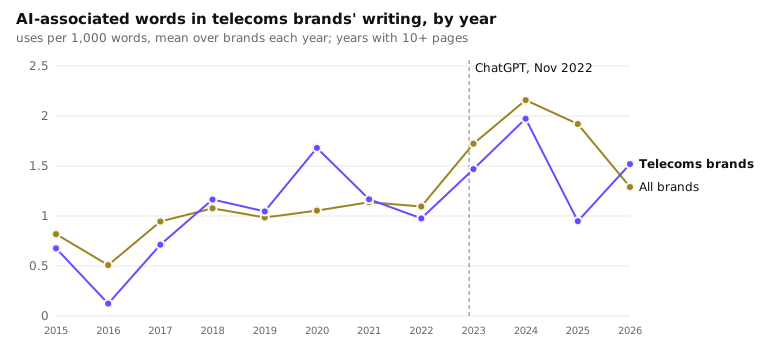
- AI-associated words in telecoms brands' writing peaked in 2024 at 1.97 per 1,000 words (ScriptGrain, 2026; 15 brands, brand-weighted by year).
Sample
15 UK mobile, broadband and TV providers from ScriptGrain's brand deep corpus (October 2026): blog posts, press releases, product announcements and information packs from their own sites, fetched on 4 and 5 October 2026, plus archived pages from 2015 to November 2022. 1,816 pages measured.
- Written by the brand on its own site or newsroom, in English
- At least 150 words of main text
- Not a link list or menu
Method
Plan: the sector reports were set out in the series pre-registration (docs/research/brand-series-preregistration.md section 6) before any page was measured: the SGR-010 tables for the sector against all other sectors, and the SGR-011 measures within the sector, exploratory, with intervals.
Text and measures: as in SGR-010. Each page's main content reduced to plain text and counted in code.
Weighting: each brand's pages are averaged first, then brands, here and for the other nine sectors.
Years: pages with a date from their metadata, structured data or URL, or an archive capture date. A year is shown for the sector when it has 10 or more pages.
Before and after: SGR-011's rule, inside the sector: a brand channel with at least 10 dated pages from 2019 to November 2022 and 10 from 2024 on.
Variables measured
- Words per sentence
- Sentence length variation
- Long words (7+ letters)
- "You" share of I, we, you
- "We" share of I, we, you
- Contractions per 1,000 words
- Questions per 1,000 words
- Exclamation marks per 1,000 words
- Em dashes per 1,000 words
- AI-associated words per 1,000
- AI-era marketing words per 1,000
- Words per page
What each measure means
- Habits
- Words per sentence and its variation (standard deviation over mean), the share of words of seven letters or more, the "you" and "we" shares of all I, we and you words, and contractions, questions, exclamation marks and em dashes per 1,000 words, all counted in code by the same functions as SGR-010.
- AI-associated words
- Uses per 1,000 words of three published word lists: words studies of scientific writing found language models over-use, words publicly mocked as ChatGPT tells, and AI-era marketing words ("seamless", "elevate", "unlock", "empower"…). AI-era marketing words are the last list on its own. The same measure as SGR-007. Humans use all of these words; the rate says nothing about who wrote a page.
- Other sectors
- The brand-weighted average of the other nine sectors' brands: banks, energy, telecoms, software, supermarkets, travel, insurance, fashion, charities, and food and drink, less this one.
- Rank
- Where the sector's brand-weighted average sits among all 10 sectors, 1 being the highest.
- Brand range
- The 25th to 75th percentile of the sector's brand averages: the middle half of its brands.
- Distinctive words
- Words this sector uses more than the others, ranked by a log-odds score. A word counts only if at least three of the sector's brands use it and no one brand supplies more than half its uses; brand names and page furniture are removed.
- 95% interval
- From 2,000 bootstrap resamples of the sector's brands.
Findings
- More questions than other sectors (4.2 against 2.9 (+44%)): Telecoms brands ranked 2nd highest of 10 sectors. The middle half of the sector's brands ran from 2.9 to 5.3.
- More "you" than other sectors (62% against 48% (+28%)): Telecoms brands ranked 3rd highest of 10 sectors. The middle half of the sector's brands ran from 52% to 78%.
- More AI-era marketing words than other sectors (1.06 against 0.88 (+20%)): Telecoms brands ranked 2nd highest of 10 sectors. The middle half of the sector's brands ran from 0.63 to 1.35.
- More contractions than other sectors (17.5 against 15.5 (+13%)): Telecoms brands ranked 3rd highest of 10 sectors. The middle half of the sector's brands ran from 13.1 to 21.6.
- AI-associated words by year (Peak in 2024: 1.97 per 1,000 words): Across all 10 sectors the peak was 2024 (2.16). Telecoms brands ranked 2nd highest of 10 sectors on these words over the whole period.
- Press releases against the same brands' blogs (Less "you" (−16.9 points, 95% interval −34.8 to −1.0); fewer contractions (−4.0, 95% interval −7.4 to −0.7)): Nine telecoms brands had at least five of each. Positive numbers mean the press releases had more.
- Before and after ChatGPT (exploratory) (0.88 to 1.32 AI-associated words per 1,000; four brands): Four of the 15 telecoms brands had at least 10 dated pages in one channel both before ChatGPT (2019 to November 2022) and from 2024. In that writing, AI-associated words went from 0.88 to 1.32 per 1,000 words (+0.44, 95% interval −0.53 to 1.33). With four brands, treat that as a description of those brands, not of the sector.
What this study does not show
- That any page, or any brand, used AI to write. Word counts show style; humans used these words before ChatGPT and keep using them.
- That voice measurement, ScriptGrain's or anyone's, can tell whether a text was written by AI. Nothing in this study tests that.
- That one telecoms brand's writing is better than another's, or that the sector's habits work. Nothing here measures readers, sales or search.
How telecoms brands write, against the other nine sectors
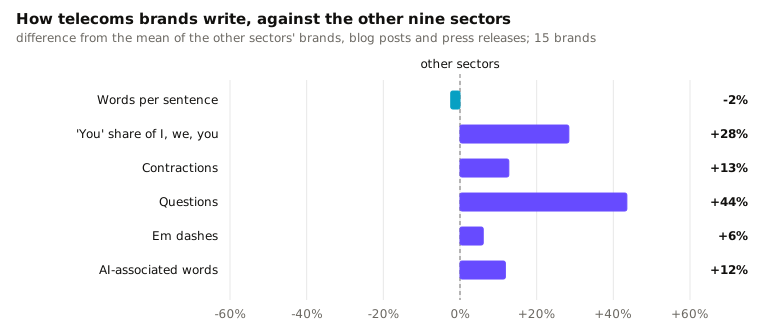
Every habit measured
Brand-weighted averages. Rank among all 10 sectors, 1 being the highest.
| Habit | Telecoms brands | Other sectors | Middle half of the sector's brands | Rank of 10 |
|---|---|---|---|---|
| Words per sentence | 13.0 | 13.3 | 11.3 to 14.4 | 7 |
| Sentence length variation | 0.76 | 0.78 | 0.68 to 0.80 | 5 |
| Long words (7+ letters) | 24% | 26% | 21% to 27% | 7 |
| "You" share of I, we, you | 62% | 48% | 52% to 78% | 3 |
| "We" share of I, we, you | 33% | 46% | 20% to 42% | 8 |
| Contractions per 1,000 words | 17.5 | 15.5 | 13.1 to 21.6 | 3 |
| Questions per 1,000 words | 4.2 | 2.9 | 2.9 to 5.3 | 2 |
| Exclamation marks per 1,000 words | 0.61 | 1.38 | 0.20 to 0.67 | 8 |
| Em dashes per 1,000 words | 2.40 | 2.26 | 1.64 to 3.01 | 3 |
| AI-associated words per 1,000 | 1.28 | 1.14 | 0.86 to 1.60 | 2 |
| AI-era marketing words per 1,000 | 1.06 | 0.88 | 0.63 to 1.35 | 2 |
| Words per page | 1,004 | 1,114 | 762 to 1,136 | 6 |
AI-associated words by year
Words this sector uses more than others
Uses per 10,000 words. Mostly the sector's subject matter; the voice is in the habits above.
| Word | Telecoms brands | Other sectors |
|---|---|---|
| phone | 46.1 | 3.7 |
| internet | 28.4 | 1.4 |
| network | 29.7 | 4.0 |
| devices | 20.9 | 1.1 |
| sports | 19.0 | 0.9 |
| device | 19.6 | 1.8 |
| connection | 17.4 | 1.5 |
| pro | 17.6 | 1.6 |
| speed | 19.1 | 2.2 |
| phones | 20.9 | 0.3 |
Press releases against blogs, within the same brands
Press releases minus the same brand's blog posts, averaged over the nine telecoms brands with at least five of each (95% interval in brackets).
| Measure | Difference |
|---|---|
| Words per sentence | +1.8 (−0.6 to 4.4) |
| "You" share | −16.9 (−34.8 to −1.0) points |
| Contractions per 1,000 words | −4.0 (−7.4 to −0.7) |
| AI-associated words per 1,000 | −0.29 (−0.88 to 0.21) |
Before and after ChatGPT, within the sector (exploratory)
Four of the 15 telecoms brands had at least 10 dated pages in one channel both before ChatGPT (2019 to November 2022) and from 2024. In that writing, AI-associated words went from 0.88 to 1.32 per 1,000 words (+0.44, 95% interval −0.53 to 1.33). With four brands, treat that as a description of those brands, not of the sector.
| Measure | 2019 to Nov 2022 | 2024 on | Change (95% interval) |
|---|---|---|---|
| AI-associated words per 1,000 | 0.88 | 1.32 | +0.44 (−0.53 to 1.33) |
| AI-era marketing words per 1,000 | 0.64 | 1.15 | +0.51 (−0.16 to 1.19) |
| AI sentence shapes per 1,000 | 0.36 | 0.39 | +0.04 (−0.19 to 0.23) |
| Em dashes per 1,000 words | 2.77 | 2.25 | −0.53 (−2.22 to 1.82) |
| Words per sentence | 14.62 | 14.15 | −0.47 (−1.92 to 0.58) |
Limitations
- 15 brands. A sector average can move with one or two brands; the brand range column shows the spread.
- Pages are what each brand publishes on its own sites. Brands that publish little have few pages.
- Counts of surface habits only. They describe style, not quality.
- Descriptive. Differences from other sectors are reported without significance tests.
Competing interests
ScriptGrain sells writing-voice measurement, and the analyst builds it. The sector reports were planned in the series pre-registration before any page was measured, every number is a count made in code, and the data and scripts are public.
Reproducing this
- Scripts: scripts/experiments/brand-series/sectors.mjs, sector-charts.mjs and sector-entry.mjs in the ScriptGrain repository.
- Every page's URL, brand, sector and measures are in the brand writing dataset below.
Data
- Summary: all six sector reports, habits, ranks, years, intervals (JSON) (json)
- Every page in the brand writing series, with its measures (CSV) (csv)
Released under CC BY 4.0: free to reuse, including commercially, with credit to ScriptGrain and a link to this page.
Citations
- ScriptGrain (2026). How do UK brands write? (SGR-010)
- ScriptGrain (2026). Did brand writing change after ChatGPT? (SGR-011)
How to cite
ScriptGrain (2026). How do UK mobile, broadband and TV providers write? 15 brands measured against nine other sectors (Study SGR-015, conducted 5 October 2026). Dataset licensed CC BY 4.0. https://scriptgrain.com/research/how-uk-telecoms-brands-write
About the analyst
Jack Stovell has worked in finance and data for more than twelve years, building management reporting, forecasting and profitability models for advertising agencies and tech scale-ups, from SQL and Power BI reporting to board-level analysis. Since 2016 he has run Adapt Progress Evolve, an applied AI studio, where he builds and operates AI systems and data products: ScriptGrain's measurement of writing voice across 45 attributes, UK Spend, which brings 16.7 million rows of UK council spending into one queryable dataset, and more than thirty AI agents running in production. He designs ScriptGrain's studies and is accountable for every number in them.