Has the em dash really taken over? Em dashes per 1,000 words in books, research papers and brand writing, 1800 to 2026
SGR-019, conducted 2026-10-13. Analyst: Jack Stovell, founder, ScriptGrain.
Question: How often did published writing use the em dash from 1800 to 2026, did its use in brand writing, research abstracts and company homepages rise after ChatGPT beyond its earlier trend, and is today's rate high or low against 19th-century books?
Summary
Background. Since ChatGPT launched in November 2022, the em dash has been called the sign of a machine-written text. Our earlier studies measured it in pieces: SGR-004 on company homepages and SGR-011 on UK brands' blogs and press releases. This study puts every body of writing ScriptGrain holds on one axis, from 19th-century books to the 2026 web, and asks two plain questions: has the em dash risen beyond where its own trend was heading, and is it high or low against the books of the 1800s?
What we did. We fixed six hypotheses, the dash definition for each kind of text and the pass or fail rule for each in public before the full count. Then we counted em dashes per 1,000 words (U+2014, spaced en dashes, and the plain-text conventions "--" in books and "---" in arXiv abstracts) in 2,059,475 arXiv abstracts from 2015 to 2026, 7,464 dated blog posts and press releases from 100 UK brands, 2,950 company homepages from 2000 to 2026 (SGR-004's published counts), and 1,276 whole books from Project Gutenberg. For each of the three modern bodies of writing we fitted the 2015 to November 2022 trend, carried it forward, and tested whether 2024 onward sits above it.
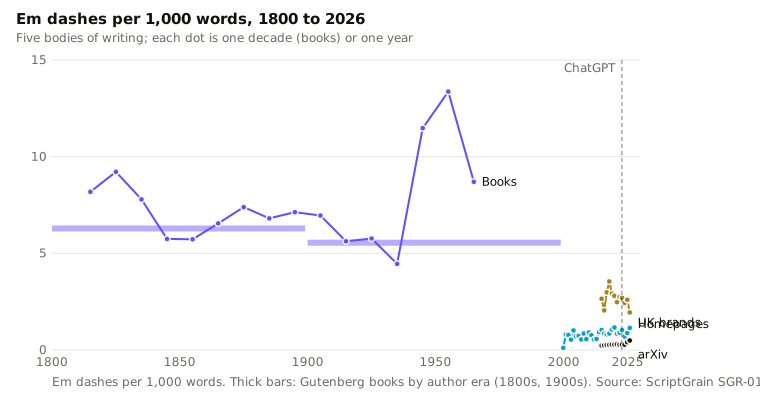
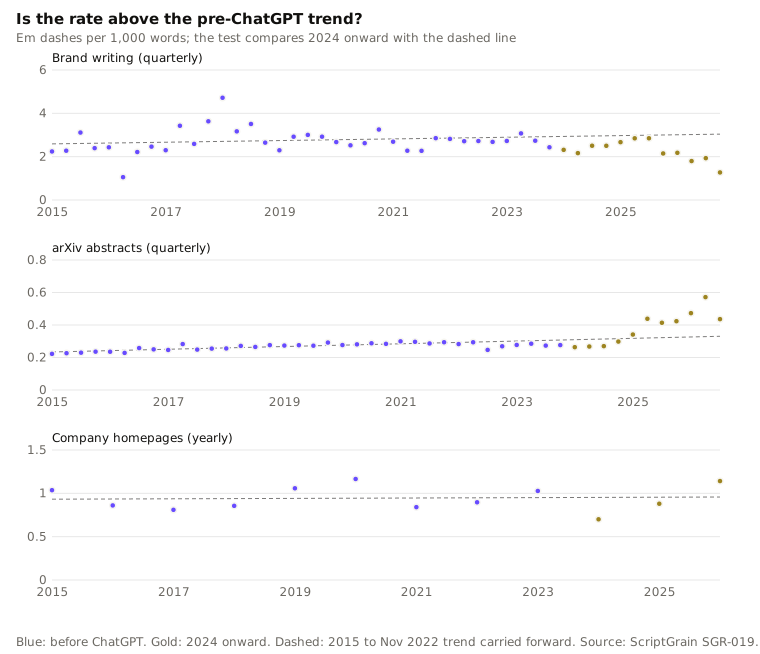
What we found. UK brands' blogs and press releases: 2.72 em dashes per 1,000 words in 2019 to November 2022 and 2.28 from 2024 on (a ratio of 0.84, 95% interval 0.72 to 1.01). arXiv abstracts: 0.28 in 2019 to November 2022 and 0.40 from 2024 on (a ratio of 1.40, 95% interval 1.18 to 1.67). Against the trend projected from before ChatGPT, brand writing was not clearly different from it, arXiv abstracts were above it and homepages were not clearly different from it. The arXiv rise came late: 0.28 per 1,000 words in 2024, 0.41 in 2025 and 0.49 in 2026. Nineteenth-century non-fiction books used 4.89 per 1,000 words and fiction 7.07, so brand writing today is lower than the non-fiction books of the 1800s.
What it means. On these collections the em dash has not taken over. Brand writing and company homepages since 2024 sit where their own earlier trends pointed; arXiv abstracts sit above theirs, but at 0.40 per 1,000 words they use the mark far less than the other collections; and today's brand writing uses it about half as often as 19th-century non-fiction books (a ratio of 0.47). A count of dashes shows how writing looks; it does not show who or what wrote it.
Key numbers
- UK brands' blog posts and press releases used 2.72 em dashes per 1,000 words in 2019 to November 2022 and 2.28 from 2024 on (ScriptGrain, 2026; 100 brands, pre-registered).
- arXiv abstracts went from 0.28 per 1,000 words in 2019 to November 2022 to 0.40 from 2024 on (2,059,475 abstracts).
- Nineteenth-century non-fiction books used 4.89 dash marks per 1,000 words and fiction and literary works 7.07; today's brand writing used 2.28.
- 28 of 52 brands with enough pages wrote more em dashes per 1,000 words from 2024 on than in 2019 to November 2022.
Sample
Five collections held by ScriptGrain: 2,059,475 arXiv abstracts (2015 to 2026, 333,063,827 words), 15,941 blog posts and press releases from 116 UK brands (7,464 of them, from 100 brands, dated well enough for the time comparisons), 2,950 company homepages (2000 to 2026, SGR-004), 1,276 Project Gutenberg books (108,615,578 words) and 6,600 web pages from 2021 (SGR-007).
- arXiv: the SGR-008 census, abstracts of at least 30 words, and for papers up to November 2022 only those with no later revision
- Brand writing: blog posts, press releases and announcements of at least 150 words from the brand deep corpus, dated by metadata, structured data, URL or archive capture
- Books: the SGR-005 author panel and the SGR-006 book sample, whole text between the Project Gutenberg markers, at least 5,000 words
- Homepages and 2021 web pages: the measured rows SGR-004 and SGR-007 published
Method
Pre-registration: the six hypotheses, the dash rules and the analysis were committed to the public repository before the full measurement (docs/research/sgr-019-preregistration.md). The script was tested on under 5% of the data; the test results are not reported.
Counting: one regular-expression count per text, no language model. Words are counted after dash marks are replaced by spaces, so "word--word" is two words.
Trend test: for each modern body of writing, the 2015 to November 2022 pooled rate by quarter is fitted with a weighted line and projected over 2024 onward; the hypothesis is supported if the lower end of the 95% interval of observed minus projected is above zero. December 2022 to December 2023 is left out of both sides.
Comparison with books: the ratio of today's rate to the rate in 1800s non-fiction books (and science books for arXiv), with independent bootstrap intervals; supported if the upper end is below 1.
Breadth: the share of brands (with at least five pages in each period) whose rate was higher from 2024 on than in 2019 to November 2022, with a Wilson interval.
Variables measured
- Em dash marks per 1,000 words (primary and strict)
- Share of texts with at least one dash (arXiv, brand writing, homepages)
- Source, year or era, genre, sector
What each measure means
- Em dash mark
- SGR-010's definition: the em dash character (U+2014) or an en dash with a space either side. For books, a run of exactly two or three hyphens also counts, because plain-text Project Gutenberg files spell the em dash that way. For arXiv abstracts, three hyphens or a spaced pair of hyphens counts, because arXiv stores abstracts as ASCII; an unspaced pair is LaTeX's en dash for ranges and does not.
- Strict rate
- The same count with only U+2014 and spaced en dashes, as SGR-010 counted. Reported beside the main figure so the effect of the plain-text conventions is visible.
- Per 1,000 words
- Dash marks divided by words, times 1,000, pooled over all texts in the group (long texts weigh more). A word is a run of characters containing a letter or digit; dash marks are not words.
- Pre-ChatGPT trend
- A line fitted to the pooled rate by quarter from January 2015 to November 2022 (by year, 2015 to 2022, for homepages), carried forward and averaged over 2024 onward, weighted by the words written in each period.
- 95% interval
- From 1,000 bootstrap resamples that draw whole groups with replacement: brands for brand writing, arXiv subject categories for abstracts, sites for homepages, authors for books.
Findings
- H1 (not supported): brand writing since 2024 sits above its 2015 to 2022 trend (Observed 2.28, trend 2.69, difference −0.41 (95% interval −1.06 to 0.27)): Per 1,000 words, 100 brands. The rule was that the lower end of the interval must be above zero.
- H2 (supported): arXiv abstracts since 2024 sit above their 2015 to 2022 trend (Observed 0.40, trend 0.32, difference +0.08 (95% interval 0.06 to 0.11)): Per 1,000 words, 150 subject categories. arXiv stores abstracts as ASCII, so only authors who type three hyphens or a spaced pair register here.
- H3 (not supported): company homepages since 2024 sit above their 2015 to 2022 trend (Observed 0.91, trend 0.94, difference −0.03 (95% interval −0.62 to 0.54)): Per 1,000 words, 158 sites. SGR-004's counts, which include U+2014 only and are therefore a lower bound.
- H4 (supported, supported): today's rate is below the 19th century's (Brand writing 2.28 against 4.89 in 1800s non-fiction (ratio 0.47, interval 0.39 to 0.57); arXiv 0.40 against 5.32 in 1800s science (ratio 0.08, interval 0.05 to 0.12)): The rule was that the upper end of each ratio's interval must be below 1. Book rates include editors' and typesetters' dashes as well as the authors'.
- H5 (not supported): brand writing was already rising before ChatGPT (2.88 in 2015 to 2018, 2.72 in 2019 to November 2022 (ratio 0.94, interval 0.79 to 1.17)): Supported if the lower end of the ratio's interval is above 1.
- H6 (not supported): the rise is spread across brands (28 of 52 brands higher (54%, interval 41% to 67%)): Supported if at least 60% of eligible brands rose and the lower end of the Wilson interval is above 50%.
What this study does not show
- That any text was written by AI. A dash count describes punctuation, not authorship.
- That the rise (or lack of one) since 2022 was caused by AI tools. The studies are observational and the periods differ in many other ways.
- Anything about spoken language, social media, or writing outside these collections.
- That voice measurement, ScriptGrain's or anyone's, can tell whether a text was written by AI. Nothing in this study tests that.
Em dashes per 1,000 words, 1800 to 2026
Books are plotted by the decade of publication for the SGR-005 works that have a known year; decades after the 1930s hold 4 books between them, so the end of the books line is a handful of titles. The horizontal bands are the pooled rates of every book placed in the 1800s and in the early 1900s (see Books by era).
Above or below the pre-ChatGPT trend
Pre-registered hypotheses and results
| Hypothesis | Result | Observed | Comparison | Difference or ratio (95% interval) |
|---|---|---|---|---|
| H1 brand writing above its trend | Not supported | 2.28 | trend 2.69 | −0.41 (−1.06 to 0.27) |
| H2 arXiv above its trend | Supported | 0.40 | trend 0.32 | +0.08 (0.06 to 0.11) |
| H3 homepages above their trend | Not supported | 0.91 | trend 0.94 | −0.03 (−0.62 to 0.54) |
| H4a brand writing below 1800s non-fiction | Supported | 2.28 | books 4.89 | 0.47 (0.39 to 0.57) |
| H4b arXiv below 1800s science books | Supported | 0.40 | books 5.32 | 0.08 (0.05 to 0.12) |
| H5 brand writing already rising, 2019 to 2022 against 2015 to 2018 | Not supported | 2.72 | earlier 2.88 | 0.94 (0.79 to 1.17) |
| H6 rise spread across brands | Not supported | 28 of 52 | share higher | 54% |
Books by era
Whole books from the SGR-005 and SGR-006 collections, grouped by the century in which the author turned 40 (or the work's publication year where known). The strict rate counts only the em dash character and spaced en dashes; most plain-text Project Gutenberg files spell the em dash as two hyphens, so the main rate is the fair one.
| Era | Books | Dash marks per 1,000 words | 95% interval | Strict rate |
|---|---|---|---|---|
| 1700s | 231 | 3.82 | 2.88 to 4.95 | 0.92 |
| 1800s | 503 | 6.29 | 5.45 to 7.06 | 1.59 |
| early 1900s | 542 | 5.55 | 4.88 to 6.28 | 1.74 |
Each collection by year
Pooled rate per 1,000 words with a 95% interval, and the share of texts with at least one dash where texts are counted one by one.
| Collection | Year | Texts | Words | Per 1,000 words | 95% interval | Texts with a dash |
|---|---|---|---|---|---|---|
| arXiv abstracts | 2015 | 98,402 | 14,286,881 | 0.23 | 0.20 to 0.26 | 2% |
| arXiv abstracts | 2016 | 106,269 | 15,689,112 | 0.24 | 0.22 to 0.27 | 2% |
| arXiv abstracts | 2017 | 116,436 | 17,444,447 | 0.26 | 0.23 to 0.29 | 2% |
| arXiv abstracts | 2018 | 132,932 | 20,304,983 | 0.27 | 0.24 to 0.30 | 2% |
| arXiv abstracts | 2019 | 147,213 | 22,772,903 | 0.28 | 0.25 to 0.31 | 3% |
| arXiv abstracts | 2020 | 167,223 | 26,659,253 | 0.28 | 0.26 to 0.31 | 3% |
| arXiv abstracts | 2021 | 163,481 | 26,464,950 | 0.29 | 0.25 to 0.33 | 3% |
| arXiv abstracts | 2022 | 139,926 | 22,854,486 | 0.27 | 0.24 to 0.31 | 3% |
| arXiv abstracts | 2023 | 203,120 | 33,559,068 | 0.28 | 0.24 to 0.31 | 3% |
| arXiv abstracts | 2024 | 238,596 | 39,733,971 | 0.28 | 0.24 to 0.31 | 3% |
| arXiv abstracts | 2025 | 279,293 | 46,845,754 | 0.41 | 0.35 to 0.45 | 4% |
| arXiv abstracts | 2026 | 266,584 | 46,448,019 | 0.49 | 0.42 to 0.56 | 4% |
| UK brand writing | 2015 | 310 | 283,711 | 2.65 | 1.81 to 3.40 | 56% |
| UK brand writing | 2016 | 284 | 265,258 | 2.05 | 1.53 to 2.75 | 51% |
| UK brand writing | 2017 | 339 | 318,181 | 2.98 | 2.30 to 3.84 | 60% |
| UK brand writing | 2018 | 376 | 375,664 | 3.54 | 2.70 to 4.62 | 65% |
| UK brand writing | 2019 | 719 | 664,608 | 2.92 | 2.57 to 3.23 | 68% |
| UK brand writing | 2020 | 725 | 746,387 | 2.80 | 2.36 to 3.25 | 66% |
| UK brand writing | 2021 | 1,021 | 1,016,753 | 2.48 | 2.16 to 2.79 | 64% |
| UK brand writing | 2022 | 953 | 973,279 | 2.74 | 2.30 to 3.17 | 66% |
| UK brand writing | 2023 | 499 | 590,838 | 2.69 | 2.35 to 3.18 | 69% |
| UK brand writing | 2024 | 604 | 913,118 | 2.44 | 2.04 to 2.85 | 70% |
| UK brand writing | 2025 | 690 | 1,194,221 | 2.60 | 2.22 to 3.07 | 74% |
| UK brand writing | 2026 | 944 | 1,530,683 | 1.94 | 1.51 to 2.45 | 58% |
| Company homepages | 2015 | 136 | 74,287 | 1.04 | 0.55 to 1.59 | 21% |
| Company homepages | 2016 | 132 | 67,377 | 0.86 | 0.49 to 1.32 | 20% |
| Company homepages | 2017 | 126 | 70,391 | 0.81 | 0.52 to 1.18 | 23% |
| Company homepages | 2018 | 131 | 82,910 | 0.86 | 0.53 to 1.24 | 27% |
| Company homepages | 2019 | 133 | 85,968 | 1.06 | 0.62 to 1.62 | 29% |
| Company homepages | 2020 | 132 | 82,358 | 1.17 | 0.74 to 1.67 | 30% |
| Company homepages | 2021 | 136 | 101,018 | 0.84 | 0.55 to 1.31 | 28% |
| Company homepages | 2022 | 128 | 82,534 | 0.90 | 0.56 to 1.32 | 27% |
| Company homepages | 2023 | 129 | 88,573 | 1.03 | 0.68 to 1.40 | 32% |
| Company homepages | 2024 | 125 | 109,922 | 0.70 | 0.43 to 1.03 | 29% |
| Company homepages | 2025 | 121 | 111,339 | 0.88 | 0.59 to 1.22 | 35% |
| Company homepages | 2026 | 107 | 112,132 | 1.14 | 0.79 to 1.68 | 38% |
Web pages in 2021
Published SGR-007 counts (U+2014 only), the year before ChatGPT. All 2021 pages together: 0.96 per 1,000 words (0.61 to 1.37).
| Kind of page | Pages | Per 1,000 words | 95% interval |
|---|---|---|---|
| blogging platform | 200 | 3.97 | interval n/a |
| careers advice | 200 | 0.99 | interval n/a |
| essay mills | 600 | 0.03 | 0.02 to 0.05 |
| government | 200 | 0.00 | interval n/a |
| how to content | 400 | 0.76 | interval n/a |
| marketing seo blogs | 600 | 1.00 | 0.65 to 1.77 |
| news india | 400 | 0.91 | interval n/a |
| news kenya | 600 | 0.37 | 0.22 to 0.55 |
| news nigeria | 600 | 0.43 | 0.36 to 0.49 |
| news philippines | 200 | 3.67 | interval n/a |
| news uk | 400 | 0.11 | interval n/a |
| news us | 600 | 2.44 | 1.93 to 3.32 |
| press releases | 600 | 0.37 | 0.29 to 0.52 |
| qa forum | 200 | 0.50 | interval n/a |
| self help | 600 | 2.35 | 1.15 to 4.51 |
| wikipedia | 200 | 0.59 | interval n/a |
Limitations
- Dashes in books may be the editor's or the typesetter's, not the author's, and the Project Gutenberg plain-text versions show the dash as two hyphens whichever mark the print edition used. The book rates measure the printed or transcribed text, not an author's habit.
- arXiv stores abstracts as ASCII, so an author's typed em dash survives only as three hyphens or a spaced pair of hyphens. Dashes written without spaces are missed, and the arXiv rate is a lower bound that depends on how authors type.
- The homepage counts are SGR-004's published rows: U+2014 only, with no spaced en dash, and the page text no longer exists to recount. They are a lower bound and are not pooled with the other collections.
- The collections differ in kind, so the lines in the long-run chart are not one sample of English over time. Books are literary and non-fiction works of different eras; the modern collections are marketing copy, scientific abstracts and company homepages.
- Brand pages come from fixed collection rules, not a random draw from everything a brand published, and many have no recoverable date. Archived pages (before November 2022) and live pages (after) came by different routes.
- A rise after 2022 shows a change in how text looks in the ChatGPT era. It is not evidence that any text was written by AI, and a fall would not be evidence of the reverse.
- Word counts here ignore dashes; SGR-010 counted every run of non-space characters, so rates can differ in the second decimal place.
Competing interests
ScriptGrain sells writing-voice measurement and the analyst builds it; a story about a punctuation mark said to give away machine writing is also one the product could use. The hypotheses, the dash definition and the pass and fail rules were committed to the public repository before the full count, every hypothesis is reported whichever way it came out, and the data and scripts are public.
Reproducing this
- Pre-registration, run script and entry builder: docs/research/sgr-019-preregistration.md and scripts/experiments/sgr-019/ in the ScriptGrain repository.
- Every brand page's URL, date and counts, and every book's identifier and counts, are in the data files, so any figure can be recounted from the public sources.
Data
- Summary: hypotheses, intervals, levels, exploratory cuts (JSON) (json)
- Rate by collection and year, with intervals (CSV) (csv)
- Every book: identifier, era, genre, words and dash counts (CSV) (csv)
- Every brand page: URL, date, words and dash counts (CSV) (csv)
- arXiv abstracts by month and subject group: documents, words, dash counts (CSV) (csv)
Released under CC BY 4.0: free to reuse, including commercially, with credit to ScriptGrain and a link to this page.
Citations
- ScriptGrain (2026). Did ChatGPT change how companies write? 27 years of homepages, measured (SGR-004)
- ScriptGrain (2026). Did brand writing change after ChatGPT? 37 UK brands, before and after (SGR-011)
How to cite
ScriptGrain (2026). Has the em dash really taken over? Em dashes per 1,000 words in books, research papers and brand writing, 1800 to 2026 (Study SGR-019, conducted 13 October 2026). Dataset licensed CC BY 4.0. https://scriptgrain.com/research/has-the-em-dash-taken-over
About the analyst
Jack Stovell has worked in finance and data for more than twelve years, building management reporting, forecasting and profitability models for advertising agencies and tech scale-ups, from SQL and Power BI reporting to board-level analysis. Since 2016 he has run Adapt Progress Evolve, an applied AI studio, where he builds and operates AI systems and data products: ScriptGrain's measurement of writing voice across 45 attributes, UK Spend, which brings 16.7 million rows of UK council spending into one queryable dataset, and more than thirty AI agents running in production. He designs ScriptGrain's studies and is accountable for every number in them.