Does a brand change its voice for America? The same page on UK and US sites, compared word for word
SGR-030, conducted 2026-11-20. Analyst: Jack Stovell, founder, ScriptGrain.
Question: When a brand runs both a UK and a US English website, how much of the difference between the same page on each is spelling alone, and which brands really change their voice for the other country?
Summary
Background. Many global brands run a UK site and a US site in English. Localisation is often described as a spelling swap: "colour" becomes "color" and the rest stays. We checked what actually changes, page by page.
What we did. We fixed the hypotheses, the pairing rule and the thresholds before collecting anything. For 141 brands with both sites we listed every page on each, paired pages with the same address, fetched up to 20 pairs per brand on the same day, converted British spellings to American with a fixed word list, and compared the texts word for word. Pairs that still differed were measured on six voice measures. No language model read or scored any page.
What we found. Localising a page for America is rarely a spelling swap, and rarely a change of voice. Across 61 brands with both a UK and a US English site, the median brand had 30% of its matched pages the same once British spellings were converted to American (95% interval 20% to 50%), and only 15 of 879 page pairs differed by spelling alone. Most differences were wording and content, not voice: 4 of 61 brands (7%) changed their voice on most of the pages that differed (95% interval 2% to 13%). Of all 879 pairs, 312 were word for word the same, 15 differed only in spelling, 146 were different pages (one over 25% longer than the other) and 406 were similar in length but worded differently.
What it means. Matching pages by address favours pages that were copied across unchanged, so the two sites as a whole are probably less alike than these pages. Where the copy did change, it changed what was said far more often than how it was said. The counts describe the text; they say nothing about who, or what, wrote or localised it.
Key numbers
- Median brand share of matched UK and US pages that are the same text after spelling is normalised: 30% (95% interval 20% to 50%) (61 brands; ScriptGrain, 2026).
- Of matched pages that differ as written, the median brand share that differ only in spelling: 0% (95% interval 0% to 0%) (59 brands).
- Brands that change their voice for the US site on most differing pages: 4 of 61 (7%) (95% interval 2% to 13%).
- 879 page pairs: 312 identical as written, 15 spelling only, 146 different pages, 406 reworded.
Sample
141 brands with both a UK and a US English site (verified in October 2026), of which 61 yielded at least 5 matched page pairs. Pages fetched on 20 November 2026, with the UK side fetched from Great Britain and the US side from the United States.
- A brand with a UK and a US English website, both verified to load on the intended country's site
- Pages with the same address on both sites, not the home page, legal, account, search or basket pages
- Both pages in English, at least 150 words of prose, not list-like, and still on the intended country's site after any redirect
- At least 5 such pairs for a brand to count in the headline numbers
Method
Pre-registration: the hypotheses, pairing rule, thresholds and tests were committed to ScriptGrain's research repository (docs/research/sgr-030-preregistration.md) before any page text was collected. The plan was to collect in October and measure the day before an earlier release; that slipped, so the freeze, the collection and the measurement all happened on one day, in that order, and git records the order.
Collection: Firecrawl listed every page on each site and fetched pages with its location set to Great Britain for the UK site and the United States for the US site. Up to 20 pairs per brand, chosen at random with a fixed seed, spread over the sites' sections. 3,086 credits against a cap of 5,500.
Comparison: plain text from each page, repeated navigation and footer lines removed, numbers and prices removed, British spellings converted to American, then a word-by-word comparison.
Thresholds: a voice difference counts only when it exceeds a quarter of the normal page-to-page spread within a brand, measured once on ScriptGrain's UK brand corpus before any pair was measured.
Tests: medians over brands, with 95% intervals from 1,000 bootstrap resamples of brands (fixed seed). Direction where voice differs: a sign test over brands, exploratory.
Variables measured
- Share of page pairs identical as written
- Share identical after spelling normalisation
- Share differing only in spelling
- Share of different pages
- Sentence length (words)
- Contraction rate
- "You" per 1,000 words
- Hedges per 1,000 words
- Superlatives per 1,000 words
- Reading age (years)
What each measure means
- Page pair
- The same address on a brand's UK and US sites once the locale part (/uk, /en-gb, /us) is removed, for example /uk/pricing and /us/pricing. Both pages had to load on the intended country's site, be in English and have at least 150 words of prose.
- Spelling normalisation
- Every British form in the frozen spelling list from our Americanisation study (SGR-028: -our/-or, -ise/-ize, -re/-er, doubled L and others, 1,500 forms) is converted to its American form on both pages before comparing. Capitalised words that do not start a sentence (names) are left alone.
- Word difference
- One minus twice the longest common sequence of words divided by the two pages' total words, after removing numbers, prices and dates and the lines a brand repeats on half or more of its pages. Two pages count as the same text when they differ by 2% or less.
- Different page
- Not the same text, and one page more than 25% longer than the other. Counted separately: that is a different page, not a different voice.
- Voice measures
- Average sentence length, contraction rate, "you" per 1,000 words, hedges per 1,000 words, superlatives per 1,000 words and reading age, the same counted measures as our UK vs US brands study (SGR-029).
- Voice changer
- A brand with at least 3 reworded pairs where, on at least 60% of them, at least 3 of the 6 measures differ in the brand's usual direction by more than a quarter of the normal page-to-page spread within a UK brand (for example 0.78 words of sentence length, 4.86 uses of "you" per 1,000 words).
Findings
- H1: mostly the same words (Not supported) (Median brand share identical after spelling normalisation: 30% (95% interval 20% to 50%)): Pre-registered bar: at least 50%. 61 brands with 5 or more pairs.
- H2: spelling is the main localisation (Not supported) (Median brand share of differing pages that differ only in spelling: 0% (95% interval 0% to 0%)): Pre-registered bar: at least 50%. 59 brands had at least one pair that differed as written.
- H3: a minority of brands change voice (Not supported: fewer than 10% change voice) (4 of 61 brands (7%) (95% interval 2% to 13%)): Pre-registered range: 10% to 40%. Voice changers: HSBC, Indeed, Lego, McDonald's.
- H4: direction where voice differs (exploratory) (58 brands with at least one reworded pair): Sentence length (words): median brand difference (US minus UK) -0.07; 21 of 57 brands higher on the US page; sign test p 0.063. "You" per 1,000 words: median brand difference (US minus UK) -0.21; 21 of 54 brands higher on the US page; sign test p 0.134.
What this study does not show
- That any brand's localisation is good or bad. Keeping a page the same can be the right choice.
- Which version was written first. For many global brands the US site is the original and the UK site the adaptation.
- Whether a person or a tool did the localisation.
- That voice measurement, ScriptGrain's or anyone's, can tell whether a text was written by AI.
What changed between the UK and US page, brand by brand
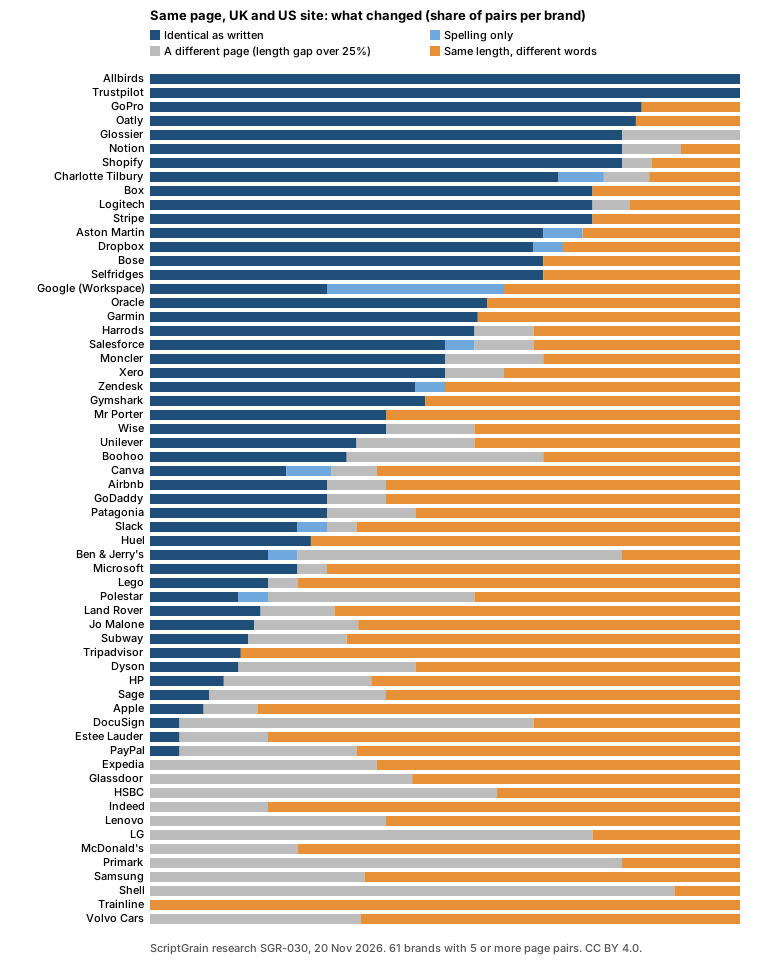
Pre-registered hypotheses and results
| Hypothesis | Result | Value (95% interval) |
|---|---|---|
| H1: median share of pages the same after spelling normalisation is 50% or more | Not supported | 30% (95% interval 20% to 50%) |
| H2: median share of differing pages that differ only in spelling is 50% or more | Not supported | 0% (95% interval 0% to 0%) |
| H3: between 10% and 40% of brands change voice | Not supported: fewer than 10% change voice | 7% (95% interval 2% to 13%) |
Where voice differed, which way
Exploratory. The median, over brands with at least one reworded pair, of each brand's median difference (US page minus UK page). A positive number means the US page is higher.
Sentence length (words): median brand difference (US minus UK) -0.07; 21 of 57 brands higher on the US page; sign test p 0.063.
"You" per 1,000 words: median brand difference (US minus UK) -0.21; 21 of 54 brands higher on the US page; sign test p 0.134.
| Measure | Median brand difference, US minus UK | Threshold for a difference |
|---|---|---|
| Sentence length (words) | -0.07 | 0.78 |
| Contraction rate | 0.00 | 0.06 |
| "You" per 1,000 words | -0.21 | 4.86 |
| Hedges per 1,000 words | 0.00 | 0.98 |
| Superlatives per 1,000 words | 0.00 | 0.59 |
| Reading age (years) | 0.00 | 0.56 |
How different are the pages that differ? (post-hoc)
Not pre-registered: added after the first run, and it changes no result above. Many pairs that count as reworded are close: 168 of the 406 reworded pairs differ by 10% of their words or less after spelling is normalised, often because of a changed paragraph, a different list of related articles or products, or reviews and listings that differ by country. Spelling conversion brought 317 of the 879 pairs closer together, so spelling is part of the change on many pages, but it is rarely the only change.
| Word difference after spelling is normalised | Page pairs |
|---|---|
| 2% or less (same text) | 327 |
| over 2% to 5% | 105 |
| over 5% to 10% | 67 |
| over 10% to 20% | 80 |
| over 20% to 40% | 99 |
| over 40% | 201 |
Checks
Fixed in the pre-registration. Each repeats the main analysis with one change.
| Check | Brands | H1 median identical | H2 median spelling only | H3 voice changers |
|---|---|---|---|---|
| Main analysis | 61 | 30% | 0% | 7% |
| Identical means within 1% (not 2%) | 61 | 20% | 0% | 7% |
| Identical means within 4% | 61 | 50% | 0% | 8% |
| A difference is 0.15 of the UK spread (not 0.25) | 61 | 30% | 0% | 16% |
| A difference is 0.5 of the UK spread | 61 | 30% | 0% | 2% |
| Without brands whose UK and US sites are separate organisations | 61 | 30% | 0% | 7% |
| Voice changers with no minimum of compared pairs | 61 | 30% | 0% | 10% |
Limitations
- Matching by address only: a page whose address was localised (/colour and /color) is not paired, which favours pages copied across unchanged, so the shares of identical pages are likely too high rather than too low.
- Brands that redirect visitors by location, block automated fetching, or run only one site are under-represented or missing; e-commerce product pages under 150 words are out.
- For many global brands the US site is the default and the UK site the adaptation; which way the copy travelled is not tested.
- Repeated navigation and footer text is removed by a fixed rule (lines on half or more of a brand's pages); some boilerplate may remain and count as a difference.
- Some pages carry text that changes by country or by day: reviews and listings (travel sites), related products and articles, and offers. That text is not the brand's own copy but counts as a difference; the post-hoc table shows how many differing pairs are close.
- The spelling list covers regular British and American spelling classes; vocabulary ("holiday" and "vacation") is not normalised and counts as a wording difference.
- The pre-registration was frozen on the day of the measurement, not weeks before; the order (freeze, then collection, then measurement) still held.
Competing interests
ScriptGrain sells writing-voice measurement and generation, with British and American English settings, and the analyst builds it. The hypotheses, pairing rule and thresholds were committed to ScriptGrain's research repository (https://github.com/StovBuilds/scriptgrain-research) before any page was collected, every result is reported whether it matched the expectation or not, and the data and scripts are public.
Reproducing this
- Pre-registration and scripts: docs/research/sgr-030-preregistration.md and scripts/experiments/sgr-030/ in ScriptGrain's research repository (collect.mjs pairs and fetches the pages, thresholds.mjs sets the thresholds, measure.mjs compares a pair, run.mjs the analysis, write-entry.mjs builds this page from the summary).
- Only counts are published; no page text is reproduced.
Data
- Brands: pairs, shares and median voice differences (CSV) (csv)
- Summary: hypotheses, intervals, checks and thresholds (JSON) (json)
Released under CC BY 4.0: free to reuse, including commercially, with credit to ScriptGrain and a link to this page.
Citations
- ScriptGrain (2026). Do UK and US brands write differently? (SGR-029)
- ScriptGrain (2026). Is ChatGPT Americanising British writing? (SGR-028)
How to cite
ScriptGrain (2026). Does a brand change its voice for America? The same page on UK and US sites, compared word for word (Study SGR-030, conducted 20 November 2026). Dataset licensed CC BY 4.0. https://scriptgrain.com/research/does-a-brand-change-its-voice-for-america
About the analyst
Jack Stovell has worked in finance and data for more than twelve years, building management reporting, forecasting and profitability models for advertising agencies and tech scale-ups, from SQL and Power BI reporting to board-level analysis. Since 2016 he has run Adapt Progress Evolve, an applied AI studio, where he builds and operates AI systems and data products: ScriptGrain's measurement of writing voice across 45 attributes, UK Spend, which brings 16.7 million rows of UK council spending into one queryable dataset, and more than thirty AI agents running in production. He designs ScriptGrain's studies and is accountable for every number in them.