Does a writer's voice change with age? 35 authors, 464 books, measured
SGR-005, conducted 2026-10-04. Analyst: Jack Stovell, founder, ScriptGrain.
Question: As writers age, which habits of their prose change and which stay fixed? Is there a general direction of change, such as longer sentences later in a career?
Summary
Background. Critics often describe writers' styles changing with age; Henry James's long late sentences are the classic example. Whether that is a general rule, and which habits stay fixed across a career, has rarely been measured across many writers at once.
What we did. We fixed two hypotheses and the rules for choosing authors before measuring anything. Wikidata gave every English-language prose work on Project Gutenberg with a first-publication date; 35 authors had at least six such books spanning at least fifteen years. From each of their 464 books we measured five passages of about 1,000 words, with dialogue removed so a change in how much dialogue a book has could not pass for a change in style.
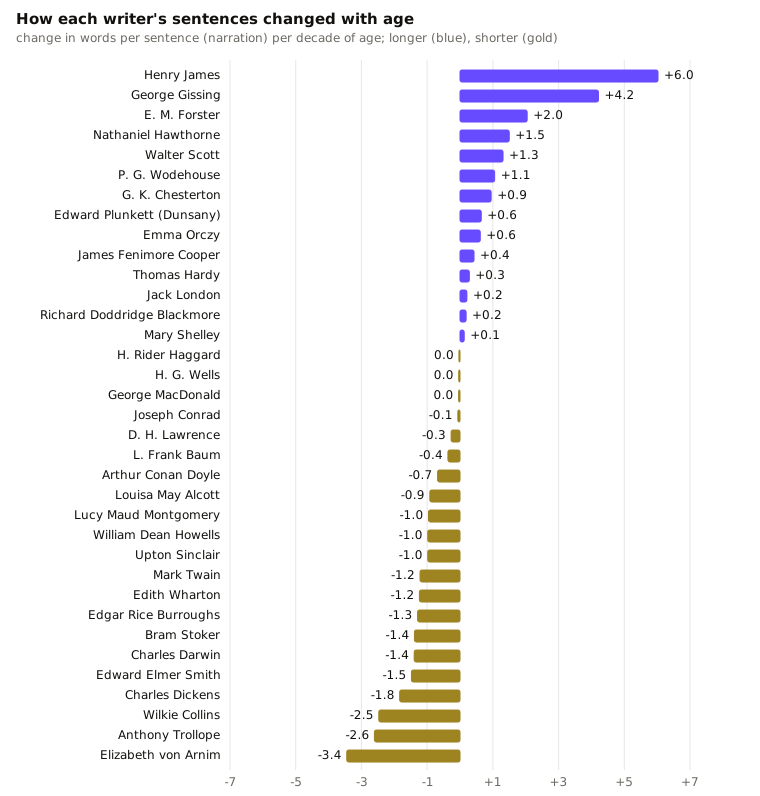
What we found. There was no general direction. 14 writers' sentences lengthened with age and 21 shortened, averaging −0.1 words per sentence per decade (95% interval −0.7 to +0.5). Henry James changed most, by +6.0 words per decade. Habits were only partly fixed: who wrote a book explained 0.34 to 0.57 of the variation in the six core habits, below the bar we had set for a stable fingerprint.
What it means. A writer's voice drifts, but in their own direction, not along a common path, and roughly half of what varies between their books is the book rather than the writer. Punctuation and word choice (commas, semicolons, long words) were the most stable parts of a voice; sentence length and contractions moved most from book to book.
Key numbers
- Across 35 English-language authors writing between 1810 and 1962, sentences did not get longer with age: 14 authors' narration sentences lengthened and 21 shortened, averaging −0.1 words per sentence per decade (ScriptGrain, 2026).
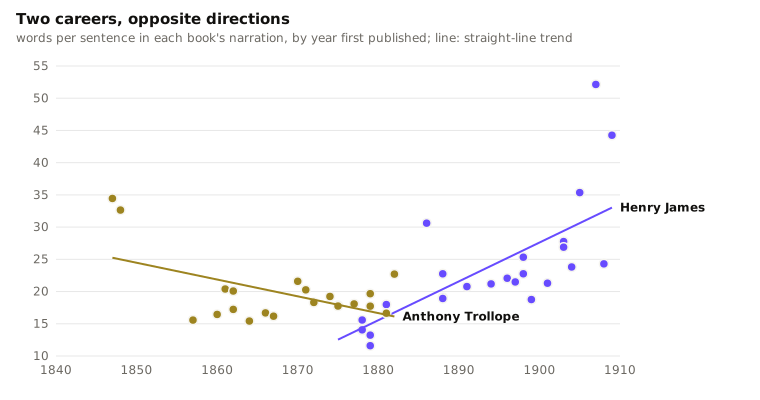
- Henry James's narration sentences lengthened by +6.0 words per decade of his age, the largest change among 35 authors; his books from 1901 to 1909 averaged 32.0 words per sentence against 16.9 in 1875 to 1886.
- Anthony Trollope moved the other way, by −2.6 words per sentence per decade, but that decline comes from his first two novels: without them his trend is +1.0.
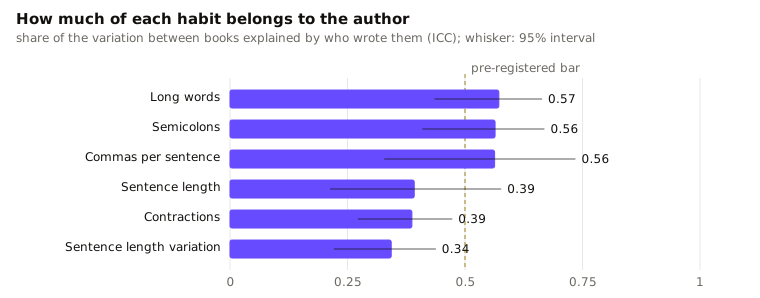
- Who wrote a book explained only 0.34 to 0.57 of the variation in six core prose habits across 464 books by 35 authors; the rest varied from book to book.
- Long words (0.57), semicolons (0.56) and commas (0.56) were the most author-stable habits; sentence length (0.39) and contractions (0.39) varied more between an author's own books.
- Writers mixed long and short sentences slightly more as they aged: sentence length variation rose across the careers of 23 of 35 authors and fell for 12.
Sample
Wikidata records (query and saved result in the repository) for English-language works with a Project Gutenberg ID, an author with birth and death dates, and a first-publication date. A date counts only if it falls between the author's 15th birthday and two years after their death; later dates are editions. Drama and poetry are excluded by Project Gutenberg subject, and every book has at least 15,000 words. 35 authors met the bar of at least six books spanning fifteen years or more: 464 books from 1810 to 1962, five passages each (2,335 passages, 2.5 million words).
- English-language prose with a first-publication date inside the author's working life
- At least six such books per author, spanning at least fifteen years
- Books of at least 15,000 words; passages of about 1,000 words at 10%, 30%, 50%, 70% and 90% of the text
Method
Pre-registration: the hypotheses, panel rules and measures were committed to the public repository before any book was measured (docs/research/sgr-005-preregistration.md). The panel is whatever those rules produce, with no hand edits.
Measurement: each passage scored with the same deterministic code ScriptGrain uses, once as narration (dialogue removed) and once as all text; a book's value is the mean of its five passages. No language model reads or scores any text.
H1: for each author, a straight-line slope of narration sentence length against age; the mean of the slopes, with a 95% bootstrap interval over authors.
H2: for six core habits, the intraclass correlation of book values within authors, with a 95% bootstrap interval over authors; supported if at least four of the six intervals sit above 0.5.
Variables measured
- Average sentence length
- Sentence length variation
- Commas per sentence
- Semicolons per 1,000 words
- Contractions per 1,000 words
- Share of long words
- Exclamation marks and dashes per 1,000 words
- Pronoun shares
- Share of words in dialogue
What each measure means
- Narration
- A passage with every run of text inside paired double quotation marks removed, so dialogue does not count. The primary measure; all-text figures are in the data.
- Change per decade
- For each author, the slope of a straight line through their books, from the measure against the author's age at first publication, scaled to ten years.
- Share explained by the author (ICC)
- The intraclass correlation of book-level values within authors: 1 would mean every book by a writer is identical on that habit, 0 that knowing the writer tells you nothing. The pre-registered bar for a fingerprint was 0.5.
- Sentence length variation
- The coefficient of variation of sentence lengths within a passage: how much long and short sentences are mixed.
- Long words
- The share of words of seven letters or more.
- 95% interval
- From 10,000 bootstrap resamples of authors (2,000 for the ICC). A hypothesis counts as supported only if the interval clears its pre-registered bar.
Findings
- H1 (not supported): sentences did not get longer with age in general (−0.1 words per sentence per decade; 95% interval −0.7 to +0.5): 14 of 35 authors' narration sentences lengthened as they aged and 21 shortened. Counting dialogue too gave the same answer (+0.0 per decade, interval −0.5 to +0.7).
- Writers drifted in their own directions (Henry James +6.0, Elizabeth von Arnim −3.4 words per decade): Henry James's late style is real: his narration sentences averaged 16.9 words in 1875 to 1886 and 32.0 in 1901 to 1909. George Gissing (+4.2) and E. M. Forster (+2.0) also lengthened. Others went the other way: Elizabeth von Arnim (−3.4), Anthony Trollope (−2.6; without his first two novels, of 1847 and 1848, his trend is +1.0, a reminder that one writer's line can rest on a few books) and Charles Dickens (−1.8).
- H2 (not supported): habits were only partly fixed (0.34 to 0.57 of the variation explained by the author): For a stable fingerprint we required the author to explain more than half of the variation, with confidence, in at least four of six core habits. None cleared that bar. Long words (0.57), semicolons (0.56), commas per sentence (0.56) came closest, with estimates above 0.5 but intervals reaching below it; sentence length (0.39), contractions (0.39), sentence length variation (0.34) varied more between an author's own books.
- Exploratory: late books mixed long and short sentences more (23 of 35 authors; +1.5 points of variation per decade): Sentence length variation rose with age for 23 authors and fell for 12, a small change whose interval sits just above zero. Semicolons tended to fall (23 of 35 authors), though that interval includes zero. These were not pre-registered and should be read as leads.
What this study does not show
- Whether the changes come from age or from the times. Within one writer, age and calendar year move together, so the two cannot be separated.
- Anything about living or modern writers. Every author here was published between the early nineteenth and mid twentieth centuries.
- That voice measurement, ScriptGrain's or anyone's, can tell whether a text was written by AI. Nothing in this study tests that.
- Whether a book is better or worse for its style. The study measures habits, not quality.
Each writer's change
Two careers, opposite directions
How much of a habit is the writer
Pre-registered hypotheses and results
| Hypothesis | Result | Test |
|---|---|---|
| H1: narration sentence length rises with the author's age | Not supported | mean −0.1 per decade (−0.7 to +0.5); 14 rising, 21 falling |
| H2: for at least four of six core habits, the author explains more than half the variation | Not supported | 0 of 6 cleared the bar |
Every author
| Author | Books | Years | Change per decade | Early books | Late books | Words per sentence, early | Late |
|---|---|---|---|---|---|---|---|
| Henry James | 26 | 1875 to 1909 | +6.0 | 1875 to 1886 | 1901 to 1909 | 16.9 | 32.0 |
| George Gissing | 9 | 1886 to 1903 | +4.2 | 1886 to 1890 | 1894 to 1903 | 15.9 | 18.1 |
| E. M. Forster | 6 | 1905 to 1924 | +2.0 | 1905 to 1907 | 1922 to 1924 | 13.7 | 17.3 |
| Nathaniel Hawthorne | 6 | 1828 to 1860 | +1.5 | 1828 to 1837 | 1852 to 1860 | 23.4 | 25.6 |
| Walter Scott | 21 | 1810 to 1826 | +1.3 | 1810 to 1819 | 1823 to 1826 | 25.5 | 27.1 |
| P. G. Wodehouse | 21 | 1905 to 1934 | +1.1 | 1905 to 1914 | 1920 to 1934 | 13.9 | 15.7 |
| G. K. Chesterton | 18 | 1901 to 1927 | +0.9 | 1901 to 1909 | 1922 to 1927 | 20.4 | 23.0 |
| Edward Plunkett (Lord Dunsany) | 9 | 1905 to 1922 | +0.6 | 1905 to 1908 | 1916 to 1922 | 27.8 | 30.1 |
| Emma Orczy | 9 | 1905 to 1925 | +0.6 | 1905 to 1910 | 1922 to 1925 | 19.6 | 20.2 |
| James Fenimore Cooper | 13 | 1820 to 1848 | +0.4 | 1820 to 1824 | 1845 to 1848 | 27.6 | 29.1 |
| Thomas Hardy | 13 | 1871 to 1913 | +0.3 | 1871 to 1876 | 1895 to 1913 | 19.8 | 20.9 |
| Jack London | 26 | 1900 to 1917 | +0.2 | 1900 to 1904 | 1913 to 1917 | 17.4 | 17.3 |
| Richard Doddridge Blackmore | 10 | 1864 to 1897 | +0.2 | 1864 to 1869 | 1887 to 1897 | 25.0 | 24.6 |
| Mary Shelley | 6 | 1823 to 1844 | +0.1 | 1823 to 1826 | 1837 to 1844 | 24.7 | 25.9 |
| H. Rider Haggard | 16 | 1889 to 1921 | −0.0 | 1889 to 1893 | 1915 to 1921 | 21.0 | 20.0 |
| H. G. Wells | 36 | 1893 to 1925 | −0.0 | 1893 to 1908 | 1915 to 1925 | 21.6 | 19.6 |
| George MacDonald | 7 | 1865 to 1895 | −0.0 | 1865 to 1871 | 1888 to 1895 | 18.9 | 19.1 |
| Joseph Conrad | 16 | 1895 to 1924 | −0.1 | 1895 to 1901 | 1912 to 1924 | 18.6 | 17.3 |
| D. H. Lawrence | 8 | 1913 to 1928 | −0.3 | 1913 to 1915 | 1924 to 1928 | 12.6 | 11.7 |
| L. Frank Baum | 17 | 1897 to 1920 | −0.4 | 1897 to 1908 | 1916 to 1920 | 18.2 | 18.3 |
| Arthur Conan Doyle | 24 | 1887 to 1927 | −0.7 | 1887 to 1892 | 1905 to 1927 | 19.7 | 17.4 |
| Louisa May Alcott | 8 | 1863 to 1886 | −0.9 | 1863 to 1866 | 1880 to 1886 | 27.6 | 24.9 |
| Lucy Maud Montgomery | 7 | 1908 to 1926 | −1.0 | 1908 to 1908 | 1923 to 1926 | 16.1 | 13.8 |
| William Dean Howells | 4 | 1879 to 1890 | −1.0 | 1879 to 1879 | 1890 to 1890 | 19.9 | 18.8 |
| Upton Sinclair | 7 | 1905 to 1930 | −1.0 | 1905 to 1911 | 1926 to 1930 | 25.8 | 22.6 |
| Mark Twain | 16 | 1872 to 1907 | −1.2 | 1872 to 1881 | 1896 to 1907 | 23.2 | 19.5 |
| Edith Wharton | 8 | 1911 to 1927 | −1.2 | 1911 to 1913 | 1924 to 1927 | 21.7 | 20.0 |
| Edgar Rice Burroughs | 22 | 1912 to 1935 | −1.3 | 1912 to 1922 | 1930 to 1935 | 22.0 | 20.5 |
| Bram Stoker | 7 | 1890 to 1914 | −1.4 | 1890 to 1902 | 1911 to 1914 | 21.1 | 20.1 |
| Charles Darwin | 7 | 1839 to 1880 | −1.4 | 1839 to 1844 | 1872 to 1880 | 30.4 | 27.4 |
| Edward Elmer Smith | 6 | 1934 to 1962 | −1.5 | 1934 to 1937 | 1953 to 1962 | 17.8 | 14.6 |
| Charles Dickens | 23 | 1836 to 1867 | −1.8 | 1836 to 1843 | 1854 to 1867 | 24.7 | 20.3 |
| Wilkie Collins | 5 | 1856 to 1881 | −2.5 | 1856 to 1856 | 1881 to 1881 | 21.3 | 15.1 |
| Anthony Trollope | 20 | 1847 to 1882 | −2.6 | 1847 to 1862 | 1875 to 1882 | 22.8 | 18.8 |
| Elizabeth von Arnim | 7 | 1889 to 1926 | −3.4 | 1889 to 1901 | 1923 to 1926 | 26.8 | 18.4 |
Every habit
| Habit | Average | Change per decade | Authors rising | Authors falling | Share explained by author |
|---|---|---|---|---|---|
| Sentence length | 20.76 | −0.1 | 14 | 21 | 0.39 |
| Sentence length variation | 0.69 | +0.0 | 23 | 12 | 0.34 |
| Commas per sentence | 1.50 | −0.0 | 13 | 22 | 0.56 |
| Semicolons | 7.05 | −0.5 | 12 | 23 | 0.56 |
| Contractions | 6.77 | −0.1 | 19 | 16 | 0.39 |
| Long words | 0.12 | +0.0 | 18 | 17 | 0.57 |
| Exclamation marks | 1.21 | −0.0 | 17 | 18 | 0.25 |
| Dashes | 4.82 | +0.4 | 21 | 14 | 0.43 |
| 'I' share of pronouns | 0.47 | +0.0 | 19 | 15 | 0.14 |
| 'You' share of pronouns | 0.20 | −0.0 | 16 | 19 | 0.19 |
| AI-tell shapes | 1.02 | −0.0 | 18 | 17 | 0.17 |
Limitations
- Project Gutenberg texts come from particular editions, and punctuation can be an editor's or printer's rather than the author's; semicolons and dashes are the most exposed.
- Wikidata's first-publication dates are mostly right but not checked book by book; a wrong date moves one point on one author's line.
- 64 books use single quotation marks for dialogue, or have none; for those, the narration measure still contains dialogue.
- Authors write different kinds of books at different times (novels, stories, travel, essays), so some change across a career is a change of form, not of voice.
- Thirty-five authors, nearly all British or American and writing between 1810 and 1962; the findings describe them, not writers in general.
Competing interests
ScriptGrain sells writing-voice measurement and generation, and the analyst builds it. The hypotheses and the rules for choosing authors were fixed and published before anything was measured, nothing was re-run or selected, and the scripts are public, so the numbers can be checked without taking our word for them.
Reproducing this
- Pre-registration, Wikidata query and saved result, panel and every script: docs/research/sgr-005-preregistration.md and scripts/experiments/sgr-005/ in the ScriptGrain repository.
- Every book is named by its Wikidata item and Project Gutenberg number in the data, so any passage can be re-read and measured.
Data
- Every book: narration and all-text measures (CSV) (csv)
- Summary: hypotheses, authors, habits (JSON) (json)
Released under CC BY 4.0: free to reuse, including commercially, with credit to ScriptGrain and a link to this page.
Citations
How to cite
ScriptGrain (2026). Does a writer's voice change with age? 35 authors, 464 books, measured (Study SGR-005, conducted 4 October 2026). Dataset licensed CC BY 4.0. https://scriptgrain.com/research/does-a-writers-voice-change-with-age
About the analyst
Jack Stovell has worked in finance and data for more than twelve years, building management reporting, forecasting and profitability models for advertising agencies and tech scale-ups, from SQL and Power BI reporting to board-level analysis. Since 2016 he has run Adapt Progress Evolve, an applied AI studio, where he builds and operates AI systems and data products: ScriptGrain's measurement of writing voice across 45 attributes, UK Spend, which brings 16.7 million rows of UK council spending into one queryable dataset, and more than thirty AI agents running in production. He designs ScriptGrain's studies and is accountable for every number in them.